An AI ML roadmap is a structured view of the skills, tools and engineering habits needed to turn data and models into software people can rely on. Knowing how a classifier trains or how to call an LLM API is one skill. Building a system that ingests data, calls a model, returns dependable answers through an application and keeps working a year after launch is another.
That gap is where careers grow. This guide treats the AI and ML roadmap as a whole chain, explains how the AI ML engineer roadmap splits into specialisations, and suggests projects that show real engineering ability. It is written for students, developers and working professionals who want to know what to build and where to focus.
Key Takeaways
- The AI/ML engineering ecosystem connects data, models, applications and infrastructure, with generative AI, LLMs and agents built on machine learning and deep learning.
- AI engineers mostly build products around existing models, while ML engineers mostly train, evaluate and serve models. The roles overlap.
- Core capabilities are data pipelines, model development, LLM applications, agents, backend APIs and MLOps.
- Generative AI work centres on LLM APIs, prompt design, embeddings, vector databases and retrieval-augmented generation (RAG), with fine-tuning as a later option.
- Production deployment needs Docker, CI/CD, versioning, cloud infrastructure and monitoring, because models degrade as data changes.
- Strong portfolio projects are complete, documented and evaluated applications with a live demo.
- Career paths include AI, ML, generative AI, NLP, computer vision, MLOps and applied AI roles. You do not need all of them.
Table of Contents
What Is the AI/ML Engineering Ecosystem?
Think of the ecosystem as layers. Artificial intelligence is the umbrella for software that performs tasks needing human-like judgment. Machine learning sits inside it, with systems that learn patterns from data instead of following hand-written rules, such as a spam filter trained on labelled emails. Deep learning uses multi-layer neural networks, which is why it handles images, audio and language well.
Specialised fields grow from these layers. Natural language processing (NLP) handles text and speech, such as classifying support tickets. Computer vision handles images and video, such as spotting production-line defects. Generative AI produces new content, and large language models (LLMs) are generative models trained on huge text collections. An AI agent uses an LLM to choose its next action, calls tools like a database or search API, and works towards a goal over several steps.
Real products combine them. An insurance claims assistant might use computer vision to read scanned forms, NLP to classify the claim, an LLM to summarise it and an agent to fetch the policy record.
AI Engineer vs Machine Learning Engineer: What Is the Difference?
An ML engineer mainly builds, trains and operates models, while an AI engineer mainly builds applications that use models, often pretrained ones. In practice the roles overlap, and titles vary between companies.
| Area | AI Engineer | Machine Learning Engineer |
| Primary responsibilities | Building AI features with existing models | Training and productionising models |
| Technical focus | Integration, LLM apps, retrieval | Pipelines, features, training, optimisation |
| Common tools | LLM APIs, LangChain-style frameworks, vector databases | Scikit-learn, PyTorch, TensorFlow, MLflow |
| Typical projects | Document assistants, support agents | Fraud detection, forecasting, recommendations |
| Deployment responsibilities | Ships and monitors the application layer, including prompts and cost | Versions and serves models, sets up retraining and monitoring |
| Required engineering capabilities | Backend development, API design, output evaluation | Software engineering, statistics, experiment tracking, MLOps |
Developers who enjoy building products and working with APIs often find the AI engineer path natural. People who like data, statistics and model performance may lean towards ML engineering. Small teams often expect both from one person, so treat the table as a spectrum.
The Modern AI/ML Engineer Roadmap: Essential Engineering Capabilities
This is the core of any AI ML engineer roadmap. Treat the six areas below as capabilities you build over time, not a fixed learning sequence.
A. Data Engineering and Data Pipelines
An AI system is only as reliable as its data. Data engineering covers ingesting data from databases, APIs, files and event streams, storing it in warehouses, lakes or object storage, and transforming it for use. Structured data such as tables differs from unstructured data such as PDFs, emails and images, which need extraction, cleaning and sometimes labelling. Pipelines automate these steps, and validation checks on schema, nulls and ranges stop silent upstream changes from damaging results. For LLM applications, stale or duplicated documents lead directly to wrong answers.
B. Machine Learning Model Development
The engineering view of modelling is about process. Start with a simple baseline and add complexity only when it earns its place. Feature engineering turns raw fields into signals, training and validation need properly separated data to avoid leakage, and evaluation metrics should reflect the real cost of errors. Experiment tracking records parameters, data versions and results so work is reproducible. The Google Machine Learning Crash Course is a free reference for these ideas, and our machine learning roadmap for beginners covers the foundational learning sequence in detail.
C. Generative AI and LLM Application Development
LLM application development starts with an LLM API: you send text and receive generated text. Prompt design shapes instructions, examples and output format. Tokens are the chunks of text a model reads and writes, and usually what you pay for. The context window is the most text the model can consider in one request.
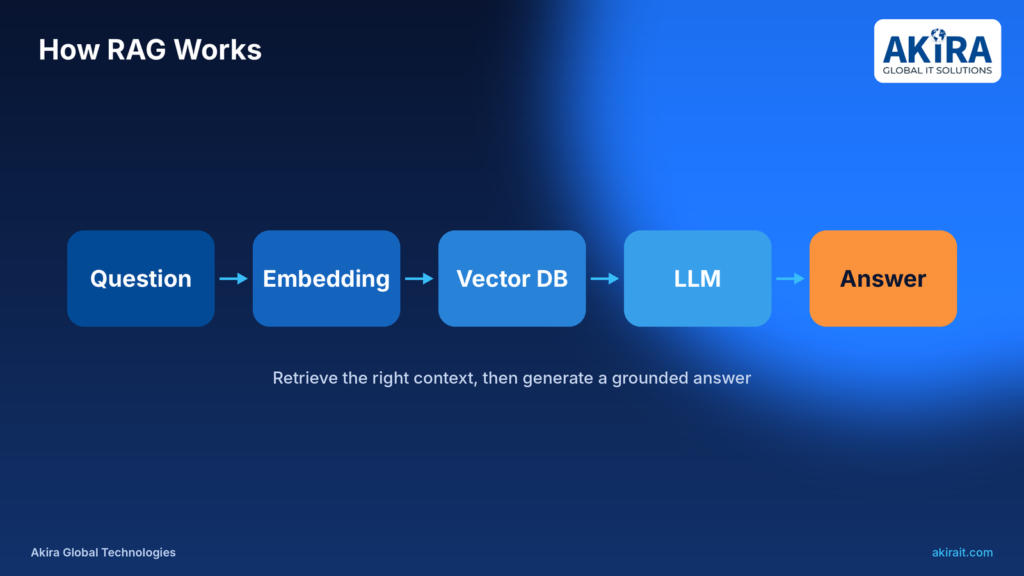
Since you cannot paste a whole knowledge base into every request, you use embeddings, numerical representations that place similar meanings close together, stored in a vector database for search by meaning. Retrieval-Augmented Generation (RAG) joins these pieces: embed the question, retrieve relevant passages, add them to the prompt and let the model answer from that material. Fine-tuning, which adjusts model weights on your own examples, usually comes after prompting and retrieval. Integration code then handles errors, retries, logging and cost.
D. AI Agent Development
An agent is an LLM inside a loop. With tool calling, also called function calling, the model returns a structured request such as “look up order 4821”, your code runs the function, and the result goes back to the model. Multi-step workflows chain these calls, with memory and context carrying results forward. Realistic uses include document processing, customer support replies and research workflows that collect and summarise sources.
Agents are not autonomous employees. They make mistakes and misuse tools. Evaluate task completion, tool choice and cost, and use human-in-the-loop approval for consequential actions such as refunds.
E. Backend and API Integration
A model in a notebook helps nobody, so backend skills matter. REST APIs expose a model or LLM workflow at an endpoint, and FastAPI and Flask are common Python choices. Authentication basics such as API keys and tokens protect the endpoint, and provider keys must stay on the server, never in frontend code. A database stores users, conversations and logs, and a frontend such as a React app sends questions to your API and shows the answers. This path separates a demo from a product.
F. MLOps and Production Deployment
MLOps applies DevOps practice to machine learning. Docker packages a model with its dependencies, MLflow tracks experiments and versions models, and CI/CD pipelines test, build and release updates automatically. Cloud platforms such as AWS, Azure or Google Cloud supply compute and storage. After launch, monitoring watches latency, errors, cost, data drift and output quality, and maintenance means retraining when performance slips.
Google Cloud’s MLOps documentation on continuous delivery and automation pipelines notes that only a small part of a real-world ML system is model code, with data, serving and monitoring making up much of the rest. Building a model is one step in a longer engineering process.
Learning each of these capabilities separately is useful, but the real skill is connecting them into one working system. Akira Global Technologies builds its AI and Machine Learning training around hands-on, project-based practice, so learners work across the chain described above, from data and models to APIs and deployment, instead of treating each tool in isolation.
Which Tools and Technologies Do AI/ML Engineers Use?
This table covers tools you build with. For coding assistants, see our guide to AI tools for developers 2026.
| Technology | Purpose | Practical Application |
| Python | Main language for data and AI services | Pipelines, training, API backends |
| Scikit-learn | Classical machine learning | Churn prediction, baselines |
| PyTorch | Deep learning framework | Vision models, fine-tuning |
| TensorFlow | Deep learning and deployment tooling | Image classifiers, mobile and edge models |
| Hugging Face | Pretrained models and datasets | Text classification, embeddings |
| LangChain or similar | Orchestration for LLM workflows | RAG pipelines, tool-calling agents |
| Vector databases | Similarity search over embeddings | Knowledge assistants, semantic search |
| FastAPI | Python API framework | Serving models over REST |
| Docker | Containerisation | Consistent deployment |
| MLflow | Experiment tracking, model registry | Comparing runs, versioning models |
| GitHub | Version control and collaboration | Code review, CI/CD, portfolio hosting |
| AWS, Azure, Google Cloud | Compute, storage, managed AI services | Hosting APIs, scheduled pipelines |
Which Real-World AI/ML Projects Demonstrate Engineering Skills?
These are complete applications, not tutorial exercises. Finishing one does not guarantee a job offer, but each shows how you handle real engineering decisions.
1. AI-Powered Document Intelligence Platform
Problem: teams read invoices or forms by hand.
Technologies: OCR, an LLM with structured output, FastAPI.
Stages: extract text, pull fields into a schema, validate, route low-confidence items to a reviewer.
Skills: pipelines, validation, human-in-the-loop design.
Evaluation: field-level accuracy on a hand-labelled sample and the share needing review.
2. RAG Knowledge Assistant
Problem: staff cannot find answers in scattered documents.
Technologies: embeddings, a vector database, an LLM API.
Stages: chunk and index documents, retrieve, answer with citations, add access control.
Skills: retrieval and prompt design, security.
Evaluation: known-answer test questions, checking retrieval relevance, faithfulness to sources and refusal when evidence is missing.
3. Customer Support AI Agent with Tool Integration
Problem: repetitive order and refund queries.
Technologies: an LLM with function calling, a mock order database.
Stages: define tools, add guardrails, build the loop, require approval for refunds.
Skills: agent design, API integration.
Evaluation: success on scripted scenarios, correct tool choice, escalation accuracy, cost per conversation.
4. Predictive Analytics and Decision-Support System
Problem: predict churn or equipment failure and guide action.
Technologies: Scikit-learn, MLflow, FastAPI, Docker.
Stages: baseline, tracked experiments, explainability, deployment, drift monitoring.
Skills: model development and MLOps.
Evaluation: precision and recall at a chosen threshold against the baseline, and the cost of wrong decisions.
5. Computer Vision Quality Inspection Application
Problem: spot product defects from images.
Technologies: PyTorch, a pretrained vision model, an inference API.
Stages: label images, fine-tune, evaluate each defect class, serve, test under new lighting. Skills: deep learning, edge cases.
Evaluation: per-class precision and recall, false-negative rate, latency.
6. Intelligent Recommendation Platform
Problem: help users find relevant products or content.
Technologies: embeddings, filtering methods, a vector search index.
Stages: prepare interaction data, generate candidates, rank, handle new users.
Skills: ranking, system design.
Evaluation: precision at k, coverage and diversity offline, then online tests if real users exist.
AI/ML Career Paths and Specialisations
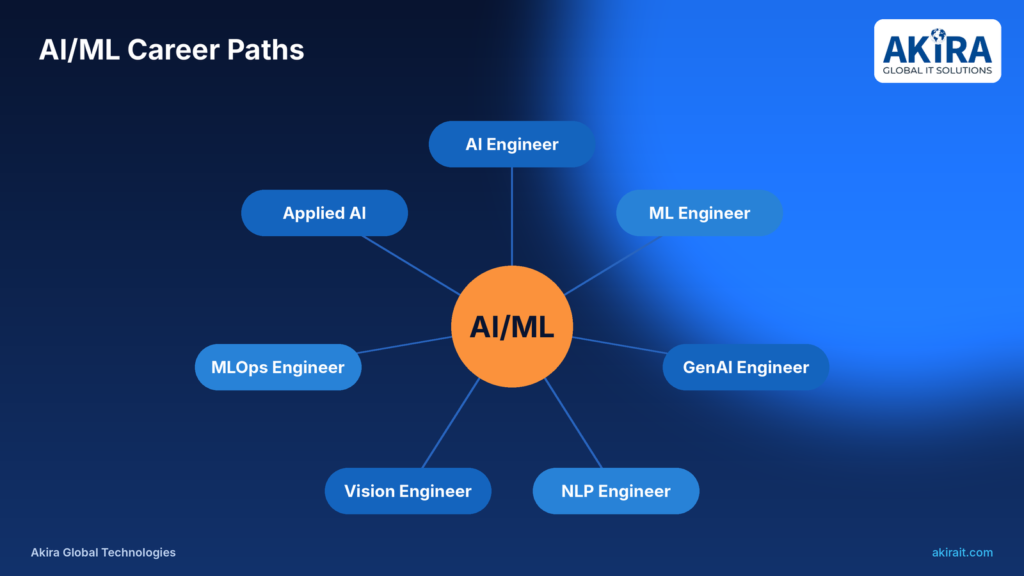
| Role | Responsibilities | Technical Focus | Relevant Skills |
| AI Engineer | Builds AI features into products | LLM apps, integration | Python, APIs, RAG |
| Machine Learning Engineer | Trains and serves models | Training, pipelines | Scikit-learn, PyTorch, SQL |
| Generative AI Engineer | Builds LLM products and agents | RAG, fine-tuning, agents | Embeddings, tool calling |
| NLP Engineer | Builds language systems | Classification, extraction, search | Transformers, Hugging Face |
| Computer Vision Engineer | Builds image and video systems | Detection, segmentation | PyTorch, data labelling |
| MLOps Engineer | Automates ML infrastructure | Deployment, monitoring | Docker, cloud, CI/CD |
| Applied AI Engineer | Solves domain problems with AI | Problem framing, delivery | Domain knowledge, ML basics |
You do not need to master every specialisation at once. Build a strong base in one area, then add neighbouring skills as projects require them.
How to Build a Strong AI/ML Engineering Portfolio
A working demo is the minimum. A valuable project shows engineering judgment: why you chose an approach, how you tested it and what you would change next. Include:
- GitHub repositories with clean structure and a clear README.
- Architecture diagrams showing data flow and where the model sits.
- API documentation, which FastAPI can generate automatically.
- Deployment links and short demonstrations so reviewers can try the system.
- Evaluation results with metrics and known failure cases.
- Problem-solving notes on trade-offs and mistakes you fixed.
Guided practice can make this part easier. Akira Global Technologies combines live classes and assignments with hands-on projects, mentor feedback, mock interviews and resume building, which helps learners turn project work into a portfolio that is ready for review. The goal is not just a working demo, but a project you can explain and defend clearly.
Common Challenges in AI/ML Engineering and How to Address Them
- Poor data quality: validate at ingestion, version datasets and fix problems at the source.
- Hallucinations and unreliable outputs: ground answers with retrieval, request structured output, require citations and test against a fixed evaluation set.
- Data privacy: send models only what they need, mask sensitive fields, control access and check provider data policies.
- Model performance issues: compare with a simple baseline, inspect errors by segment and retrain on representative data.
- High inference costs: use smaller models where quality allows, cache repeated requests and set usage limits.
- Deployment complexity and maintenance: containerise early, automate releases, and monitor drift, latency and cost.
How to Choose the Right AI/ML Career Direction
Start from what you already do well. People interested in software development may explore AI application engineering. Those drawn to data and predictive systems may prefer ML engineering. Anyone fascinated by language-based products can look at LLM and NLP development, and people who like infrastructure may enjoy MLOps.
If you are unsure which specialisation fits you, it helps to start with an honest look at your current skills. Akira Global Technologies begins its learner journey with a career consultation and skill assessment, which can help you compare directions such as AI engineering, ML engineering or MLOps before you commit to a course and a project path.
If you are starting from scratch, an AI ML roadmap for beginners comes first, and a structured AI ML learning course can add guided practice before you commit. Try one small project in two directions and notice which holds your attention.
Frequently Asked Questions
1. What does an AI/ML engineer roadmap include?
It includes data engineering, model development, LLM and RAG applications, agent design, backend and API skills, and MLOps for deployment and monitoring. It also covers choosing a specialisation and building end-to-end projects. Beginners can learn foundations first, then move into these system-level skills.
2. What is the difference between an AI engineer and a Machine Learning engineer?
An ML engineer mainly trains, evaluates and deploys models, while an AI engineer mainly builds applications around existing models such as LLMs. The roles overlap and titles vary. ML engineering leans towards data and modelling, AI engineering towards integration, retrieval and workflow design.
3. Which skills are required to become an AI/ML engineer?
Key skills include Python, data handling, core machine learning concepts, SQL, API development, Git, Docker and cloud basics. Generative AI roles add prompt design, embeddings, vector search and evaluation. Problem framing, testing habits and clear communication of technical decisions matter just as much.
4. Is Generative AI knowledge necessary for an AI/ML engineer?
It is increasingly useful but not necessary for every role. Forecasting, computer vision and many ML engineering jobs still rely mainly on traditional methods. Basic familiarity with LLM APIs, RAG and evaluation is still a sensible investment whichever specialisation you choose.
5. What projects should an aspiring AI/ML engineer build for their portfolio?
Build complete applications rather than isolated notebooks: a RAG knowledge assistant, a document extraction tool, a support agent with tool calling and a deployed predictive model with monitoring. Each should include documentation, evaluation results and a live demo that shows how you handle real engineering decisions.
Conclusion
The AI ML roadmap is less a list of courses than a map of how data, models, applications and infrastructure fit together. Successful engineers go beyond algorithms and tools. They design systems, integrate models into real software, evaluate honestly, deploy with care and keep improving after launch. Pick one specialisation, build one complete project end to end, then expand. For structured, mentor-led practice along the way, Akira Global Technologies offers training programmes in AI and related technologies.