
Cyber Security Career for Beginners: How to Start in 2026
A cyber security career for beginners starts with three things: strong networking and operating system basics, regular hands-on practice, and a clear target role such as SOC analyst. You do not need a computer science degree or prior security experience to begin. This guide is for students, fresh graduates, and working professionals who want to move into security. It explains the skills, the learning order, and the realistic path from beginner to analyst. Because every organization stores data online, security skills are relevant across banking, healthcare, retail, education, and technology. What Is Cybersecurity and Why Does It Matter in 2026? Cybersecurity is the practice of protecting systems, networks, applications, and data from unauthorized access, damage, or disruption. Every business now relies on cloud services, mobile apps, and connected devices, so one weak point can expose customer records or stop operations. Beginners should first recognize the common threats: Security professionals monitor logs and alerts, harden systems, test applications, respond to incidents, and follow frameworks such as the NIST Cybersecurity Framework. This work rewards curiosity. Attackers keep changing their methods, so defenders must keep learning. That is why cybersecurity suits people who enjoy problem solving, investigation, and steady improvement more than memorizing facts. Is Cybersecurity a Good Career for Beginners? Yes, it can be, provided you expect steady skill building rather than instant results. Security teams need people from many backgrounds, including IT support, development, testing, and networking. The roles below are common starting points and destinations. Role What You Do Beginner Fit SOC Analyst Monitor alerts and triage incidents Strong entry route with networking and log basics Penetration Tester Run authorized tests on systems and apps Usually needs prior hands-on practice GRC Analyst Manage policies, risk, and compliance Good for process-minded learners Cloud Security Associate Review access and configurations Suits learners with cloud basics The skills you need depend on the role. Analysts lean on logs, alerts, and networking. Testers need deeper knowledge of applications and scripting. Compliance roles need strong documentation and risk thinking. Choose a direction early, but stay flexible, because your first role often shapes the next one. Be realistic. Many professionals start in helpdesk, IT support, or junior SOC positions and grow from there. Timelines vary, and no course can guarantee a job. Software testers can also transition: understanding what is automation testing builds scripting habits that help in security testing. Essential Skills for a Cyber Security Career for Beginners Every cybersecurity skill below builds on the one before it. Cybersecurity for beginners works best in sequence, and each skill makes the next easier to understand. Strong cybersecurity analyst skills come from combining technical depth with clear thinking. Ethical Hacking Roadmap for Beginners Ethical hacking means testing systems with permission to find weaknesses before criminals do. This ethical hacking roadmap keeps the order simple: Each step supports the next. A cyber security career for beginners grows through layered practice, not a single course or tool. If a stage feels difficult, return to the previous one before moving on. Ethical hacking roadmap for beginners infographic showing seven learning stages Always test only systems you own or have written permission to assess. Unauthorized access is illegal, including under India’s IT Act, and ethical hackers work within a defined scope and rules of engagement. Responsible disclosure, meaning reporting a weakness privately to its owner, is part of the same professional habit. How to Become a Cybersecurity Analyst If you are asking how to become a cybersecurity analyst, follow this practical sequence: Cybersecurity career path infographic from beginner to advanced specializations Your portfolio does not need to be large. Two or three well-documented labs, such as analyzing a phishing sample, reviewing a packet capture, or hardening a virtual machine, tell employers more than a long list of tools. Before applying, you should be able to explain a packet capture, read system logs, describe the incident response lifecycle, and write a short incident summary. How to Choose the Right Cyber Security Courses in India The number of cyber security courses India learners can choose from keeps growing, so evaluate them carefully. A strong program should teach concepts first, then reinforce them with practice: A well-designed cyber security training course should let you verify these points on its syllabus page before you pay. Common Mistakes Beginners Should Avoid Most setbacks in a cyber security career for beginners come from avoidable habits. Start Your Cybersecurity Learning Journey with Akira Global Technologies Akira Global Technologies is an IT solutions and training company that offers courses across areas such as cloud, DevOps, data, AI, automation testing, and cybersecurity. Its Cybersecurity Training Course is listed as a 60-hour, instructor-led program for freshers, students, career switchers, and IT professionals, with basic computer literacy as the prerequisite. According to the course page, the syllabus covers networking, system security, web application security, ethical hacking basics, security operations, cloud security, and GRC. About 60 percent of the program is hands-on, using isolated virtual labs and tools such as Wireshark, Nmap, Burp Suite, and Splunk Free or ELK. Learners also complete a team-based capstone, and the course includes career guidance and a certification roadmap. Please confirm current batches and fees with the admissions team. Beyond cybersecurity, Akira also offers software development, AI solutions, staffing, and corporate training, so learners who later want adjacent skills, such as cloud or DevOps, can explore related programs. For anyone planning a cyber security career for beginners, a structured path with labs and clear ethics rules can shorten the guesswork. Summary: Your Cybersecurity Career Roadmap for 2026 Frequently Asked Questions Yes, beginners can start without prior experience. Begin with networking, operating systems, and security basics, then practice in labs. Many people enter through IT support or helpdesk roles. A structured learning plan makes a cyber security career for beginners far more achievable. It depends on your background and study time, but most beginners need several months of steady effort to build job-relevant fundamentals, and advanced specializations take longer. Consistent weekly practice matters more than speed. Treat
How to Use ChatGPT to Learn Programming Faster
Most beginners do not struggle with programming because they lack talent. They struggle because they get stuck, have nobody to ask, and lose momentum. A forgotten semicolon, a confusing error message, or a concept that never quite clicks can end a study session early. This is where you can use ChatGPT to learn programming in a smarter way. Used well, it works like a patient tutor that explains ideas in simple words, reviews your code, and gives you practice problems at any hour. Used badly, it becomes a shortcut that hands you answers and leaves your skills exactly where they were. In this guide, you will learn how to use ChatGPT as a learning partner, with copy-ready prompts, real Python examples, and a clear process you can follow from day one. At Akira Global Technologies, we want beginners to build a proper learning routine around AI tools, and this guide shows you how. This guide shows how to build a proper learning routine around them. What Is ChatGPT and How Does It Help You Learn to Code? ChatGPT is a conversational AI assistant from OpenAI. You type a question or instruction in plain English, and it replies with explanations, examples, and code. Because it keeps the context of your conversation, you can ask follow-up questions as many times as you need. For learners, that is the real value. Textbooks and videos move at one speed. ChatGPT adapts to yours. If a loop explanation does not make sense, you can ask for a simpler one, a real-world analogy, or a different example. OpenAI has also introduced a Study and learn option, announced in July 2025, which guides users through problems step by step instead of giving the answer straight away. You can read about it in OpenAI’s study mode announcement. Feature names, menus, and plan availability change over time, so check your own ChatGPT account. You can get the same effect in any chat by asking for hints rather than answers, and the prompts in this guide are written to do exactly that. Why Use ChatGPT to Learn Programming? Four practical reasons make learning to code with AI worth your time. These benefits only matter if you stay actively involved. The learning happens when you think, type, fail, and fix. ChatGPT should support that cycle, never replace it. How to Use ChatGPT to Learn Programming Step by Step Here is a simple routine you can repeat for every topic. It keeps you in control and makes sure you actually learn. Step 1: Set the Role and Your Level Start a new chat with a clear instruction. This one prompt shapes every answer that follows. You are a patient programming tutor. I am a complete beginner learning Python. Explain things in simple language, use short examples, and ask me a question at the end of each explanation to check my understanding. Do not give full solutions unless I ask. Step 2: Learn One Small Concept at a Time Ask for a single idea, such as variables, conditions, or loops. Small topics are easier to remember and easier to test. Step 3: Write Code Yourself Before Asking for Help Try the exercise first, even if your attempt is messy. A wrong attempt teaches more than a copied right answer. Step 4: Ask for a Review, Not a Replacement Paste your code and ask what could be improved. You will see how your thinking differs from a cleaner approach. Step 5: Explain It Back Tell ChatGPT in your own words what the code does and ask it to correct you. If you can explain it clearly, you understand it. Choosing Your First Programming Language Which language should a beginner learn first? For most beginners, Python is a strong first choice. Its syntax reads close to plain English, and it is widely used in web development, automation, data analysis, and AI and machine learning. If you are unsure, describe your goal to ChatGPT and let it help you compare options: I want to build websites and later move into data analysis. Compare Python, JavaScript, and Java for a beginner with this goal. Keep it short and tell me which you would start with and why. Treat the answer as a starting point, then confirm it against job listings or course outlines in your area. The best language is the one that matches your goal and that you will actually practice. Using ChatGPT to Understand Programming Concepts How do you use ChatGPT to understand programming concepts? Ask for the idea in layers: a plain-English definition, an analogy, a small code example, and then a quiz. Try this: Explain Python variables to me like I am a complete beginner. Use a real-life analogy, show one short code example, then ask me two questions to test my understanding. A good answer will compare a variable to a labeled box or container, then show something like this: name = “Asha” age = 21 is_student = True print(name, age, is_student) How to learn from the response: Do not stop at reading. Change the values, add a new variable called city, and print it. Then answer the two quiz questions in the chat. If you get one wrong, ask ChatGPT to explain why, without repeating the same analogy. Other useful prompts for concepts: Learning Python with ChatGPT How can you use ChatGPT to learn Python? Follow a sequence: basics first, then control flow, then data structures, then functions, then small projects. Ask ChatGPT to teach one stage at a time and test you before you move on. A reliable Python order looks like this: Here is a prompt that keeps you active: Teach me Python conditions. Start with a two-sentence explanation, then give me a tiny example. After that, give me three practice tasks of increasing difficulty and wait for my answers before showing anything else. Once you are comfortable with the core language, think about where you want to go next. If your goal is building complete web applications,
Top 10 Java Projects for Beginners to Build a Standout Portfolio in 2026
Learning Java syntax is one thing. Getting hired as a Java developer is another. Plenty of beginners finish tutorials, understand loops, classes, and interfaces, and still struggle to land interviews. The reason is simple: employers want proof that you can build something that works. That is where Java projects for beginners make the difference. A well-chosen project shows that you can turn concepts into working software, solve problems, and explain your decisions. It gives a recruiter something concrete to open, run, and review. At Akira Global Technologies, our mentors have guided many learners from their first “Hello, World” to job-ready portfolios. Our approach is project-driven, so every concept is tied to something you build. The ten Java project ideas below follow the same progression, and they match a modern Java Full Stack developer roadmap from core language basics to databases, Spring Boot, and React. Why Building Java Portfolio Projects Is Non-Negotiable Certificates show that you studied. Java portfolio projects show that you can apply what you studied. Hiring managers see many resumes listing the same skills, so working code is the easiest way to stand apart. If you are still planning your learning path, our guide to the Java Full Stack developer roadmap explains which skills to learn in what order before you start building. Here is what good projects demonstrate: Recruiters and technical interviewers often check GitHub profiles and ask for live demo links. A project they can click through, plus a clear README, tells them more in two minutes than a skills list can. This is why Java projects for beginners should be the centerpiece of your job search, not an afterthought. The Top 10 Java Projects for Beginners The projects below are ordered by difficulty. Start at the top and work down, or skip ahead if you already know the basics. Each one targets specific skills that employers look for. 1. Student Management System (Console-Based) Difficulty: Beginner Core skills learned: Why it’s great for a portfolio: This is the classic first project, and it proves you understand the fundamentals. A clean, well-structured version shows more skill than a messy, ambitious one. Description: Build a menu-driven app where users add, view, update, and delete student records. Create a Student class, store objects in a collection, and keep the menu logic separate from the data logic. Once it works, add search by name or ID and sorting with comparators. 2. Library Management System (Console + JDBC) Difficulty: Beginner to Intermediate Core skills learned: Why it’s great for a portfolio: It is your first project that persists data. Connecting Java to a database such as MySQL or PostgreSQL is a skill every backend role expects. Description: Model books, members, and borrowing records in separate tables. Use PreparedStatement for queries, which also protects against SQL injection. Add features like issuing a book, returning it, and calculating late fees. Keep database code in its own classes so the structure stays clean. 3. Banking Application (Core Java) Difficulty: Beginner to Intermediate Core skills learned: Why it’s great for a portfolio: Banking logic naturally demands rules, such as no negative balances and no overdrafts without permission. It is an excellent way to show you can design around business constraints. Description: Create account types like Savings and Current that extend a base Account class. Implement deposit, withdraw, and transfer methods, and throw custom exceptions such as InsufficientFundsException. Add a transaction history using a list of transaction objects. Use BigDecimal for money instead of double, since floating-point types can introduce rounding errors. 4. To-Do List Application (GUI with JavaFX or Swing) Difficulty: Intermediate Core skills learned: Why it’s great for a portfolio: Moving from a console to a graphical interface teaches you how user actions trigger code. It also makes your project easier to demo to non-technical interviewers. Description: Build a desktop app where users add tasks, mark them complete, set priorities, and delete them. JavaFX is the more modern choice, while Swing is still found in many legacy systems. Save tasks to a file or a small database so they remain after the app closes. 5. Simple Chat Application (Sockets) Difficulty: Intermediate Core skills learned: Why it’s great for a portfolio: Concurrency is a topic interviewers love, and this project makes it tangible. You will see firsthand why thread safety matters. Description: Create a server that accepts multiple client connections, with each client handled on its own thread. Messages sent by one client are broadcast to the others. Start with a console client, then add a GUI. Use a thread-safe collection to track connected users, and handle disconnections gracefully. 6. Quiz Application (REST API with Spring Boot) Difficulty: Intermediate Core skills learned: Why it’s great for a portfolio: This is the ideal entry point into Spring Boot projects. Spring Boot is the dominant framework for Java backends, and a working REST API shows you are ready for modern development. Description: Expose endpoints to fetch questions, submit answers, and return scores. Structure the code into controller, service, and model layers. Start with questions held in memory, then move them to a database later. Test your endpoints with Postman or a similar tool, and add input validation with Bean Validation annotations. To learn how to build APIs like this professionally, with code reviews and mentor feedback, explore our Java fullstack training course, which covers Spring Boot in a project-based format. 7. Blog or Personal Journal (REST API + Spring Data JPA) Difficulty: Intermediate Core skills learned: Why it’s great for a portfolio: It shows you can model real data relationships and let an ORM handle persistence. Nearly every business application involves related entities. Description: Build an API where users create posts, and posts have comments and tags. Define entities with JPA annotations, create repository interfaces, and expose endpoints for each resource. Add pagination so the API does not return every post at once. Adding authentication with Spring Security later makes this project even stronger. 8. Weather App (REST API Consumption) Difficulty: Intermediate Core skills learned: Why
Top 10 AI Tools for Developers 2026: Features, Pricing, and Best Use Cases
AI coding tools have moved far beyond simple autocomplete. In 2026, developers can use AI to understand entire codebases, generate and edit files, debug applications, write tests, refactor projects, run commands, and even complete software tasks with limited supervision. With so many options available, choosing the right tool can be difficult. Some are built for everyday coding and autocomplete, while others focus on autonomous agents, large codebases, enterprise security, or rapid application development. This guide covers the top AI tools for developers 2026, including key features, pricing, strengths, and ideal use cases, so you can pick the best AI developer tools for your workflow. Why AI Tools for Developers 2026 Matter AI has become a core part of the modern software development workflow. Developers now use AI assistants for tasks such as: The biggest change is the shift from assistants that simply suggest code to AI agents that can perform multi-step development tasks. Tools such as Cursor, Claude Code, GitHub Copilot, and Devin can work across multiple files and handle work that once required significant manual effort. However, the best tool depends on your development environment, budget, preferred workflow, and the level of control you want over AI-generated code. 1. GitHub Copilot What Is GitHub Copilot? GitHub Copilot is one of the most established AI coding assistants. It integrates directly with popular development environments and GitHub, helping developers write, review, explain, and modify code. It supports code completion, chat, coding agents, CLI workflows, and code review. Key Features GitHub has also moved Copilot toward usage-based billing through AI Credits. Paid plans currently start at $10 per user per month, while Business and Enterprise plans start at $19 and $39 per user per month respectively. Best For GitHub Copilot is a strong choice for developers and teams that already use GitHub heavily and want coding assistance built into their existing workflow. Pricing: Free tier available. Paid plans start at approximately $10/month for individuals. 2. Cursor What Is Cursor? Cursor is an AI-first code editor based on Visual Studio Code. Instead of treating AI as an extra extension, Cursor puts it at the center of the development experience. Its agent capabilities can understand project context, edit multiple files, refactor code, and help implement features. Key Features Cursor is especially interesting for developers in India because it introduced Cursor Start at ₹649/month, with access to Cursor models, Composer, cloud agents, and other features. Its Pro plan starts at $20/month. Best For Cursor is perfect for those who frequently work on projects that require multi-file modifications or refactoring and who desire an AI-native coding environment. Pricing: Free tier available. Cursor Start in India is ₹649/month, while Pro starts at $20/month. 3. Claude Code What Is Claude Code? For developers that want AI to interact directly with their repositories and development environments, Anthropic offers an agentic coding tool called Claude Code. Instead of only suggesting the next line, it can analyze a project, make changes across multiple files, run commands, execute tests, and help complete larger tasks. Key Features Best For Files that are extremely helpful code code code code code code code code code are unfamiliar to Claude. It is also helpful for complex refactoring, debugging, testing, and AI/ML development workflows. Pricing: Subscription and API-based options are available. Pricing varies by plan and model usage. 4. ChatGPT for Coding and Codex What Is Codex? Codex is OpenAI’s coding agent for software development. It can help developers write, review, modify, and ship code. Codex is integrated into ChatGPT and is also available through developer-focused workflows. It is designed for longer tasks where the AI works through multiple steps rather than just answering a programming question. Key Features Codex is included throughout ChatGPT plans, including Free and Go, although usage limits differ per plan. Best For ChatGPT for coding is a good choice for developers who already use ChatGPT for planning, documentation, research, and technical problem-solving and want coding capabilities in the same ecosystem. Pricing: Codex is included with ChatGPT plans. Higher usage is available through paid plans and applicable credit or usage-based options. 5. Gemini Code Assist What Is Gemini Code Assist? Gemini Code Assist is Google’s AI coding helper for developers. It provides agentic development capabilities across supported environments, conversational assistance, and coding recommendations.It is especially attractive for teams already working with Google Cloud. Key Features One important change in 2026 is that Google’s consumer version of Gemini Code Assist was deprecated. Starting June 18, 2026, the consumer IDE extensions and Gemini CLI stopped serving requests, while Standard and Enterprise subscriptions remain available. Best For Gemini Code Assist is best suited to developers and organizations already using Google Cloud or other Google development services. Pricing: Standard and Enterprise plans are available. Consumer access changed significantly in 2026, so check Google’s current plans before subscribing. 6. Cline What Is Cline? Cline is an open-source AI coding agent that works inside your development environment. It can interface with external external project project terminal tools. One of its biggest advantages is flexibility, since developers can connect it to different AI model providers instead of being locked into one model. Key Features Best For Cline is a good option for developers who want more control over their AI coding workflow and prefer choosing their own model provider. Pricing: The core tool is free and open source. You pay separately for the AI model or API usage you connect to it. 7. Aider What Is Aider? Aider is an open-source AI pair-programming tool for developers who prefer working from the command line. It works directly with Git repositories and can modify existing code based on natural-language instructions. Key Features Best For Aider is particularly useful for developers who are comfortable in the terminal and want a lightweight, open-source alternative to AI-native code editors. Pricing: Free and open source. Model and API costs are charged separately. 8. Tabnine What Is Tabnine? Tabnine is an AI coding platform focused heavily on enterprise development and data privacy. Unlike many tools that
IT Training vs College Degree: What’s Better for Getting a Tech Job?
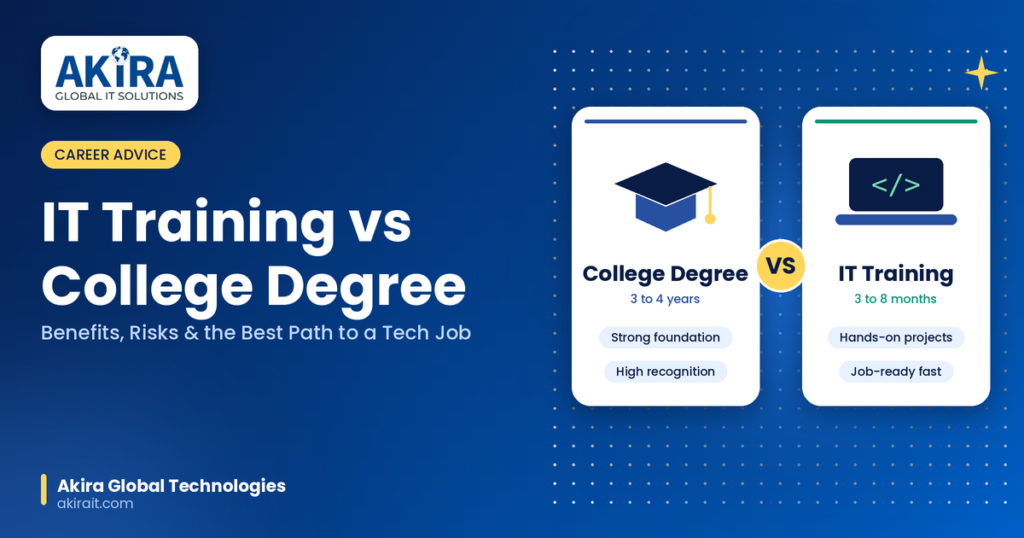
You finished school or college, and now everyone has advice. One relative says you need a B.Tech or MCA. A friend swears a three-month course got him a job at a startup. A YouTube video says degrees are dead. So which one is true? If you are a fresher or a career switcher in India, this confusion is real, and it can cost you months or even lakhs of rupees. The question of IT training vs college degree is not about which option is good and which is bad. It is about which one fits your age, budget, goals, and timeline. In this guide, you will see what each path really offers, where each one falls short, and what recruiters in Indian companies actually check. You will also get a simple step-by-step plan for 2026. By the end, you should know which direction makes sense for you, and what to do in the next 30 days. Why This Debate Matters More Than Ever Ten years ago, the path was simple. You took a degree, you sat for campus placements, and you joined a service company. That path still works for many people, but it is no longer the only one. Today, thousands of engineering graduates compete for the same entry-level roles every year. Many of them struggle to clear technical interviews because their practical skills are thin. At the same time, companies are asking for job-ready candidates who can contribute in weeks, not months. ‘Meanwhile, tools like cloud platforms, AI assistants, and DevOps pipelines change quickly. A syllabus written four years ago may not cover them. This gap is why so many people are asking whether a technical training program can do what a classroom degree sometimes cannot.’Meanwhile, tools like cloud platforms, AI assistants, and DevOps pipelines change quickly. A syllabus written four years ago may not cover them. This gap is why so many people are asking whether a technical training program can do what a classroom degree sometimes cannot. Your choice affects your salary, your confidence, and your first five years of career growth. It deserves a clear-headed look. What a College Degree Offers A degree such as B.Tech, BCA, B.Sc. Computer Science, or MCA is still the most recognised credential in India. It gives you a structured, long-term foundation. But it also comes with limits you should know about. Strengths of a Traditional Degree A computer science degree teaches you the theory behind the tools: data structures, algorithms, operating systems, databases, and networks. This foundation helps you later when you move into system design, research, or senior engineering roles. A degree also opens doors that are closed otherwise. Many large service companies, government jobs, PSUs, and higher studies like M.Tech or MBA require one. If you want to study abroad, a degree is usually mandatory. Finally, campus life gives you networking, peer learning, and sometimes on-campus placements. In tier-1 colleges, the placement record can be excellent, with fresher packages from ₹6 to ₹20 lakh per year or more. Where Degrees Fall Short The biggest problem is the gap between syllabus and industry. Many colleges, especially in tier-2 and tier-3 cities, still teach outdated tools and focus heavily on exams rather than projects. Time and cost are also factors. A four-year engineering degree can cost anywhere from ₹2 lakh in a government college to ₹15 lakh or more in a private one. That is a big investment, and there is no guarantee of a job at the end. Placement quality also varies widely. A graduate from a weak campus may get no offers at all, even with good marks. What IT Training and Bootcamps Offer IT training programs and bootcamps take a different approach. They skip most theory and focus on what employers need on day one. Here is what that looks like in practice. Strengths of IT Training The biggest advantage is speed. Most programs run from three to eight months, so you can start applying for jobs much sooner. The cost is also lower, usually between ₹30,000 and ₹1.5 lakh. Hands-on training is the core of these courses. You build real projects, use real tools, and learn the way teams actually work. Good career-ready IT training programs also include mock interviews, resume support, and placement support, which many degree colleges lack. An IT certification alongside training, such as AWS, Azure, or Oracle, adds proof of skill. It also helps your resume pass automated filters. Limitations to Consider Not all training providers are equal. Some sell glossy promises and deliver weak teaching. You must check trainer experience, project quality, and real placement records before you pay. Training also does not replace a degree in every situation. Some employers, especially large multinationals and government bodies, still list a degree as a minimum requirement. Short courses can also leave gaps in computer science basics, which you may need to fill through self-study later. IT Training vs College Degree: A Side-by-Side Comparison Here is a simple view of how the two paths compare for most learners in India. Factor College Degree IT Training / Bootcamp Cost ₹2 lakh to ₹15 lakh+ ₹30,000 to ₹1.5 lakh Duration 3 to 4 years 3 to 8 months Curriculum Broad, theory-heavy, updated slowly Narrow, skill-focused, updated often Hands-on projects Limited, varies by college Core part of the course Placement support Strong in top colleges, weak elsewhere Usually included, quality varies Industry recognition Very high, widely accepted Growing, depends on provider and portfolio The table shows a clear pattern. A degree gives you depth and recognition, while training gives you speed and practical skill. Neither wins on every row, which is why many smart candidates combine both. Online IT Courses vs Degree: Which Fits Your Situation? The online IT courses vs degree question depends mostly on where you are in life. If you are 18 or 19 and just finished Class 12, a degree is usually the safer base. You have time, and the structure helps. You can add an online course or certification
.NET Full Stack Developer Career: Salary, Skills and Roadmap for 2026
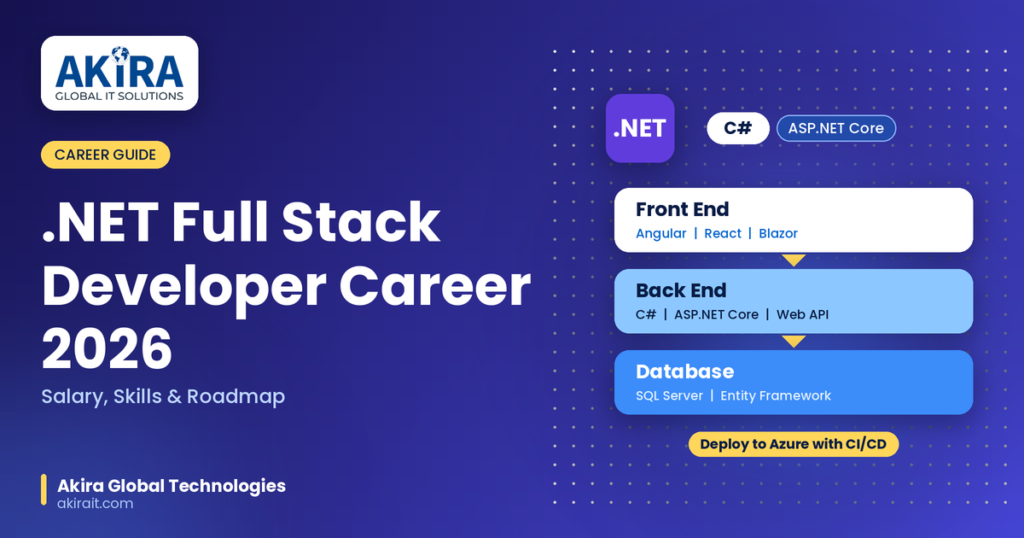
Look at what companies want from developers today and one pattern stands out. They want people who can own an application end to end, from the button a user clicks to the last row in the database. That is exactly why a .NET Full Stack Developer career is one of the most stable and well-paying paths in tech right now. Whether you are a fresher, a student, or an experienced developer switching stacks, this guide gives you a clear picture. You will learn what to study, how much you can earn, which roles to aim for, and where the field is heading. By the end, you will also have a practical, step-by-step plan you can start following this week. What Does a .NET Full Stack Developer Do? A .NET Full Stack Developer works on both sides of a web application. On the back end, they use C# and ASP.NET Core to build APIs, business logic and data access layers. On the front end, they create user interfaces with Angular, React or Blazor. In between, they handle database design, authentication, security and cloud deployment. A typical week might include building a new REST API endpoint on Monday, fixing a UI bug on Tuesday, optimizing a slow SQL query on Wednesday, reviewing a teammate’s pull request on Thursday, and deploying a release to Azure on Friday. That variety is a big part of the appeal. For employers, the benefit is simple. One skilled developer can handle multiple layers of a project, so delivery is faster and team coordination is easier. This is why startups and large enterprises alike value full stack profiles. Why Build a Career in .NET Full Stack Development? There are several practical reasons why this path keeps attracting new talent: Core Skills You Need To build a successful .NET Full Stack Developer career, you need a balanced mix of front end, back end, database and cloud skills. Front End Skills Back End Skills Database Skills Cloud and DevOps Skills Soft Skills A debugging mindset, clear communication and comfort working in Agile teams matter more than most beginners expect. In interviews, these skills often decide between two equally strong candidates. Full Stack .NET Roadmap: Step by Step Learning everything at once is the fastest way to burn out, which is why a structured .NET developer course can save you months of trial and error. This Full Stack .NET roadmap is arranged in a practical order, so each step builds on the previous one. With consistent practice, most learners become job-ready in 8 to 12 months. If you already know another programming language, you can often shorten that timeline. ASP.NET Core Tutorial: Where to Start If you are looking for an ASP.NET Core tutorial, the best approach is to build a small API from scratch rather than just reading documentation. Here is a simple sequence to follow: This short flow gives you a hands-on feel for routing, dependency injection and data access. That is the real goal of any ASP.NET Core tutorial: less reading, more building. Once you finish this mini project, try extending it with pagination, logging and unit tests. Those extras are what separate a tutorial project from a portfolio project. .NET Developer Salary in 2026 The .NET developer salary depends on experience, city, company size and skill stack. The ranges below are approximate and based on market trends, so verify current data when you are evaluating an offer. India (per annum) Level Experience Approx. Salary Entry 0 to 2 years ₹4 to 7 LPA Mid 3 to 6 years ₹8 to 15 LPA Senior 7+ years ₹16 to 30 LPA+ United States (per year) Level Approx. Salary Entry $70,000 to $90,000 Mid $95,000 to $130,000 Senior $135,000 to $170,000 Metro cities such as Bengaluru, Hyderabad, Pune and Mumbai usually pay higher than smaller cities, though remote roles are narrowing that gap. Product companies and well-funded startups tend to pay more than service companies at the same experience level. Factors that push your .NET developer salary higher: Job Roles on This Path A strong .NET Full Stack Developer career can lead to a wide range of roles: Most people start as a junior developer, move to a senior role within four to six years, and then choose between a technical track (architect) and a management track (engineering manager). Certifications Worth Considering A good .NET certification course will not replace real experience, but it helps your resume get noticed. These are worth considering: Recruiters give more weight to real projects than to certificates, so treat certifications as a supplement. How to Land Your First .NET Job Getting the first job is usually the hardest part. These steps make it easier: Common Mistakes to Avoid Future Scope of .NET Full Stack Development The outlook remains positive for several reasons: Developers who keep learning, especially cloud and AI-related skills, will stay in demand for years. Tips to Grow Faster Conclusion A .NET Full Stack Developer career offers a rare mix of technical growth, good pay and long-term stability. The path is clear: start with C#, build depth in ASP.NET Core and a front end framework, then add databases and Azure. The one rule that matters most is to keep building projects as you learn. If you want structured guidance or industry-level project experience, connect with Akira Global Technologies and give your .NET career the right direction. Frequently Asked Questions 1. What is the average .NET developer salary in India? Entry-level developers typically earn ₹4 to ₹7 LPA. Senior professionals can reach ₹16 to ₹30 LPA or more, depending on skills and company. 2. What skills are required for a .NET Full Stack Developer career? C#, ASP.NET Core, Entity Framework Core, SQL Server, a front end framework (Angular or React) and basic Azure knowledge. 3. Is .NET full stack a good career in 2026? Yes. Demand for .NET remains steady in enterprise, cloud and microservices projects, and full stack profiles have an edge in hiring. 4. How long does it take to
10 Proven IT Courses That Guarantee High-Paying Jobs in 2025

These 10 Proven IT Courses that Guarantee High paying jobs in 2025To stay relevant and competitive in this ever-evolving landscape, it’s essential to acquire cutting-edge skills that are aligned with industry needs. Whether you’re a beginner or an experienced professional aiming to pivot or upskill, these Top 10 IT Courses which guarantee job in 2025 offer excellent job prospects and a secure career path. Several of these are available through AKIRA IT Solutions, which emphasizes hands-on, industry-focused training. 1. Full Stack Development Full Stack Development is the Best IT course for jobs which equips learners with the skills to build complete web applications from scratch, covering both front-end and back-end technologies. You’ll learn HTML, CSS, JavaScript, React or Angular on the front end, and Node.js, Express, MongoDB, or Java on the back end. The course emphasizes real-world projects, API integration, and deployment strategies to help you become a versatile web developer. Whether you’re building single-page apps or enterprise platforms, this course ensures you have the hands-on expertise to thrive. Who Should Take It: Aspiring web developers Software engineers aiming to enhance their skill set IT professionals seeking full-stack development expertise Career Path:Graduates can work as Full Stack Developers, Java Developers, or Software Engineers, engaging in end-to-end application development—from database design to user interface and deployment. Top Companies Hiring: Capgemini, Infosys, TCS, Wipro 2. Salesforce Admin & Developer This course covers both administrative and development aspects of Salesforce, the world’s leading CRM platform. You’ll learn to configure Salesforce, manage users, automate workflows, and develop custom applications using Apex and Visualforce. The curriculum is designed to prepare you for Salesforce certifications, making you job-ready for roles in CRM management and custom app development within the Salesforce ecosystem. Who Should Take It: CRM professionals Business analysts Developers interested in cloud-based solutions Career Path:Professionals can aim for roles like Salesforce Administrator, Salesforce Developer, or CRM Consultant, customizing and maintaining Salesforce environments to meet business requirements. Top Companies Hiring: Deloitte, Accenture, Cognizant, IBM 3. Python Programming Python is one of the most versatile and beginner-friendly programming languages used across web development, data science, automation, and more. This course introduces you to Python fundamentals, data structures, functions, and libraries like Pandas and NumPy. With a focus on practical applications, this course empowers learners to build scripts, automate tasks, and develop small-scale projects that form the foundation for specialized fields such as machine learning and backend development. Who Should Take It: Beginners in programming Data science enthusiasts Software developers expanding their language proficiency Career Path:Learners can pursue careers as Python Developers, Data Analysts, or Machine Learning Engineers, contributing to projects in web development, automation, and data-driven research. Top Companies Hiring: Google, Netflix, IBM, Capgemini 4. DevOps Engineering DevOps Engineering focuses on integrating development and IT operations for faster software delivery and enhanced reliability. This course covers key tools such as Docker, Jenkins, Kubernetes, Ansible, and CI/CD pipelines. You’ll learn how to automate software builds, testing, and deployments in cloud-native environments. Ideal for those aiming to reduce release cycles and manage scalable infrastructure efficiently. Master DevOps Engineering Trough the Course Offered by Akira IT Solutions. Who Should Take It: System administrators Software developers IT operations professionals Career Path:Roles include DevOps Engineer, Site Reliability Engineer (SRE), or Automation Architect, focusing on optimizing, automating, and maintaining end-to-end software delivery pipelines. Top Companies Hiring: Amazon Web Services, Red Hat, Infosys 5. Cybersecurity & Ethical Hacking This course offers comprehensive training in protecting networks, systems, and data from cyber threats. You’ll learn ethical hacking techniques, penetration testing, vulnerability assessment, and the fundamentals of network security. Designed for future security professionals, this program provides hands-on labs and simulation exercises that mirror real-world attacks, preparing you for roles like security analyst or penetration tester. Who Should Take It: System administrators Software developers IT operations professionals Career Path:Roles include DevOps Engineer, Site Reliability Engineer (SRE), or Automation Architect, focusing on optimizing, automating, and maintaining end-to-end software delivery pipelines. Top Companies Hiring: Amazon Web Services, Red Hat, Infosys 6. Cloud Computing (AWS, Azure, GCP) Master the leading cloud platforms—AWS, Microsoft Azure, and Google Cloud Platform—in this in-depth course. You’ll gain expertise in deploying applications, managing storage and databases, and building scalable cloud-native solutions. The course also covers DevOps integration and serverless architecture, giving you a strong foundation to pursue roles such as cloud engineer, solutions architect, or systems administrator. Visit Akira IT Solutions to learn more. Who Should Take It: IT professionals System administrators Developers aiming for cloud proficiency Career Path:Roles such as Cloud Engineer, Cloud Architect, or Cloud Consultant involve designing, deploying, and maintaining cloud infrastructure that meets business requirements. Top Companies Hiring: IBM, Oracle, TCS, Infosys 7. Data Science & Big Data Analytics This course dives into data extraction, processing, and visualization using tools like Python, R, SQL, Hadoop, and Spark. You’ll learn how to work with massive datasets to uncover patterns, build predictive models, and drive data-driven decisions. With a blend of statistical techniques and hands-on projects, the course prepares you for careers in data science, business intelligence, and analytics consulting. Who Should Take It: Statisticians Analysts IT professionals interested in data science Career Path:Positions such as Data Scientist, Data Analyst, or Business Intelligence Analyst involve extracting insights from complex data sets and guiding data-driven decision-making. Top Companies Hiring: Facebook, Netflix, IBM, Capgemini 8. Artificial Intelligence & Machine Learning Explore the future of technology with AI & ML training focused on neural networks, deep learning, natural language processing, and model deployment. You’ll work with libraries like TensorFlow, Keras, and Scikit-learn. The curriculum balances theory and practice to help you understand how intelligent systems learn from data and solve real-world problems across industries. Who Should Take It: Software engineers Data scientists Researchers in AI Career Path:Roles include AI Engineer, Machine Learning Engineer, or AI Researcher, focusing on developing and deploying intelligent systems. Top Companies Hiring: Google, Microsoft, Amazon, Accenture 9. UI/UX Design This course guides you through the principles of user interface and user experience design, from research and wireframing to prototyping and
Promoting Your Online Business on Pinterest
When I noticed that over 60% of my own traffic was coming from Pinterest (where I have around 6600 followers) and only 3% was coming from Instagram (where I have 110k+ followers) — despite the fact that I was spending way less time on Pinterest and way too much time on Instagram I knew I needed to change my game plan.
Why Online Courses Are the Future of Education
High quality education can make all the difference in people’s lives. It helps individuals escape poverty, earn a promotion, or find better paid jobs. But getting a university degree or a training certificate often costs a lot of money, and strict class schedules clash with work shifts, preventing people from enrolling in educational programs.