
Salesforce Career Guide 2026: Roles, Certifications & Salary
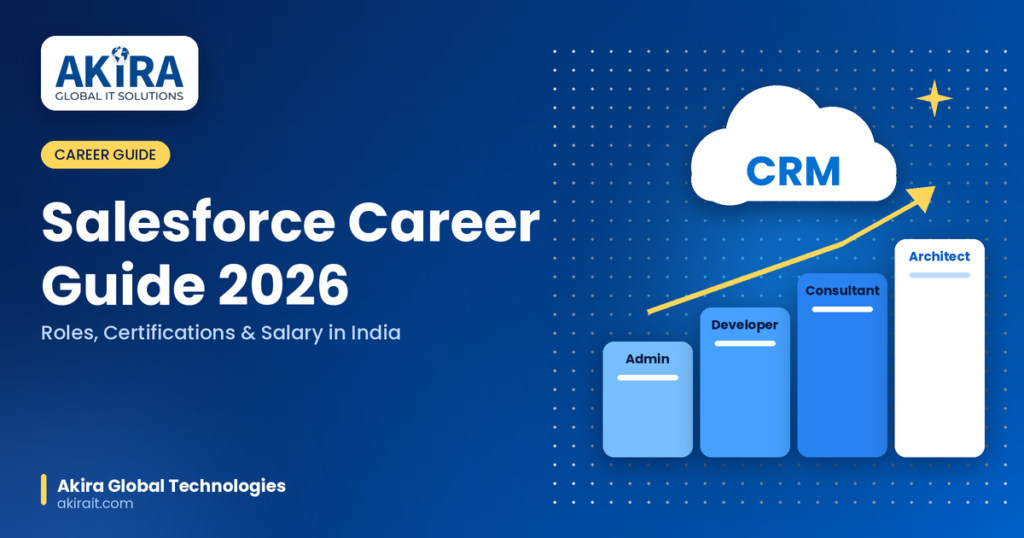
If you are considering a career in Salesforce, you may have questions about which roles are available, whether you need coding skills, which certifications matter, and how much Salesforce professionals earn in India. The good news is that a Salesforce career is not limited to software developers. The Salesforce ecosystem includes administrators, developers, consultants, business analysts, architects, data professionals, and other technology and business roles. This Salesforce career guide 2026 explains the main career paths, skills, certifications, salary considerations, and practical steps to help you decide where to start. Salesforce Career at a Glance What Is a Salesforce Career? Salesforce is a cloud-based CRM platform that businesses use to manage customer information, sales, service, marketing and business processes. However, companies need professionals to configure, customize, maintain and improve their Salesforce environments. That creates opportunities across both technical and business-focused roles. A Salesforce Administrator may manage users, permissions, reports, dashboards, data and automation. A Salesforce Developer works more deeply with programming, custom applications, integrations and business logic. This means you do not necessarily need to become a programmer to begin a Salesforce career. Your ideal path depends on your background, interests and the type of work you want to do. Salesforce Career Path: Which Role Should You Choose? One of the biggest mistakes beginners make is trying to learn the entire Salesforce ecosystem at once. Instead, choose one role and build your skills around it. Salesforce Administrator Salesforce Administrators focus on configuring and managing the platform. Typical responsibilities include: Administration can be a practical starting point for people who enjoy business processes, organization and problem-solving but do not want a heavily programming-focused role. Salesforce Developer Salesforce Developers work on the programming and technical side of the platform. Important skills can include: This path generally requires stronger programming knowledge than the core Admin path. Salesforce Business Analyst Business Analysts focus on understanding business requirements, documenting processes and communicating between stakeholders and technical teams. This can suit professionals who enjoy requirements gathering, communication, documentation and process improvement. Salesforce Consultant Salesforce Consultants help businesses understand their requirements and design appropriate Salesforce solutions. The role combines platform knowledge with business and communication skills. Salesforce Architect Architects work on complex Salesforce environments involving areas such as application design, data, security, integrations and large-scale implementations. Architecture is generally a long-term career direction rather than an entry-level role. Skills You Need for a Salesforce Career in 2026 The skills you need depend on your chosen role, but a strong Salesforce professional typically develops a combination of platform, technical and business skills. Core Salesforce skills Developer skills Business and professional skills In 2026, AI literacy is also becoming increasingly relevant. Salesforce is expanding its AI and Agentforce ecosystem, while Salesforce’s 2026 India research reports growing use of AI in workplace workflows. Salesforce Certifications to Consider in 2026 Certifications can help demonstrate structured knowledge, but they should support practical learning rather than replace it. 1. Salesforce Certified Platform Administrator For beginners targeting Salesforce Administration, the Salesforce Certified Platform Administrator certification is a logical starting point. Salesforce currently lists no prerequisite for this certification. It is relevant to professionals learning configuration, users, data, reports, dashboards and automation. 2. Salesforce Certified Platform Developer For people targeting development roles, the Salesforce Certified Platform Developer credential is more relevant. Salesforce currently lists no prerequisite for the certification, while Platform Developer II requires Platform Developer first. 3. Salesforce Certified Platform Administrator II Platform Administrator II is a progression for professionals who already hold the Platform Administrator certification and want to demonstrate more advanced administration knowledge. 4. Business Analyst and Other Certifications Salesforce also offers certifications covering Business Analysis, consulting, architecture, data, marketing, development and other specialties. The right certification depends on the role you want rather than the number of credentials you can collect. Is Salesforce Trailhead Free? Yes. Salesforce Trailhead is Salesforce’s learning platform and provides free learning content, guided learning paths, badges and hands-on practice. Salesforce also provides Trailhead Playgrounds where learners can practice Salesforce skills. For beginners, Trailhead can be a useful starting point before investing in structured training or certification preparation. However, learning modules alone are not enough. Try to build practical projects involving users, data, reports, automation and business scenarios so you can demonstrate what you have learned. Salesforce Salary in India in 2026 Salesforce salaries in India vary significantly depending on experience, role, technical specialization, location and employer. Instead of treating one number as a guaranteed salary, consider the following as indicative market ranges: Role / Experience Indicative Range Entry-level Salesforce Admin ₹4–8 LPA Entry-level Salesforce Developer ₹6–12 LPA Salesforce Admin, 3–5 years ₹8–15 LPA Salesforce Developer, 3–5 years ₹12–28 LPA Senior / specialized roles Can exceed ₹25 LPA These figures should be treated as broad benchmarks rather than guaranteed salaries. Public salary datasets can vary considerably, and specialized skills such as development, integrations, architecture, data and complex automation can affect compensation. Certification can strengthen your profile, but it does not automatically guarantee a salary increase. Practical experience, technical depth, projects, communication skills, employer and location can all influence compensation. Salesforce Career Opportunities in India The Salesforce ecosystem has a significant presence in India. A Salesforce-sponsored IDC study projected that Salesforce and its partner ecosystem will create 1.3 million jobs in India by 2026, including direct and indirect jobs. This is an ecosystem-level economic estimate, not a count of Salesforce-specific vacancies. For someone planning a Salesforce career, this means it is important to look beyond a single job title. Opportunities can exist across administration, development, consulting, business analysis, data, architecture, customer success and related technology functions. Salesforce Admin vs Developer Factor Salesforce Admin Salesforce Developer Technical requirement Low to moderate Moderate to high Main focus Configuration, users, data, reports and automation Programming, applications and integrations Coding Not usually required for core Admin work Important Key skills Flow, configuration, data and security Apex, LWC, APIs and testing Suitable for Business-minded and process-focused professionals People interested in programming Career progression Admin, Consultant, Business Analyst, advanced Admin roles Developer, Technical Consultant,
What Is SailPoint? A Beginner’s Guide to Identity Governance
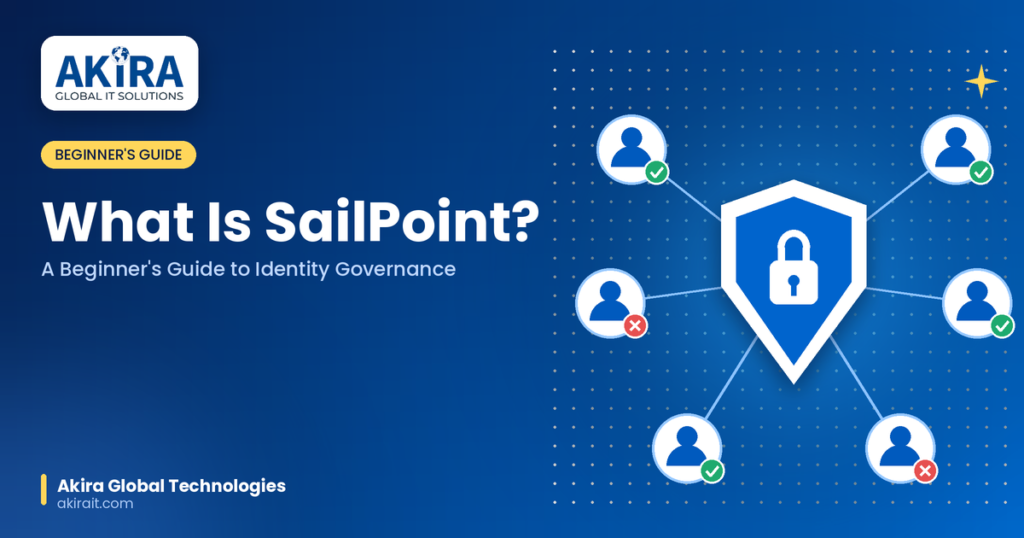
Every employee, contractor, bot, and application in your company holds a key to something. Multiply that across thousands of users and hundreds of systems, and nobody can say with confidence who can access what. That gap is where breaches, failed audits, and costly mistakes begin. So, what is SailPoint? SailPoint is an enterprise identity security platform that controls who has access to which applications, data, and systems, and proves that the access is appropriate. It is the name most associated with identity governance, and one of the most in-demand skills in IAM today. In this guide, you will learn what SailPoint does, how its products differ, what a SailPoint IIQ tutorial should cover, what the career path pays, and how to start learning. What Is SailPoint? Definition and Overview SailPoint is an identity governance and administration (IGA) platform that automates how organizations grant, review, and remove user access. In plain terms, it answers three questions: Who has access? Should they have it? Can you prove it? SailPoint was founded in 2005 in Austin, Texas. Thoma Bravo acquired the company in 2022, and SailPoint returned to the public markets with a Nasdaq listing in 2025. Large banks, healthcare systems, retailers, and government agencies use it to manage millions of identities. You can explore the vendor’s own overview on the official SailPoint website. Why does it matter now? Cloud adoption, remote work, and AI-driven attacks have made stolen or excessive access the easiest way into a company. Analyst firms such as Gartner consistently place IGA at the center of modern identity strategy, and SailPoint is regularly named among its leaders. Why Identity Governance Matters Identity governance is the practice of managing digital identities and their access rights throughout their lifecycle, so the right people have the right access at the right time. Think of it like building security. A visitor badge should expire, a manager’s badge should open more doors than an intern’s, and someone should check the badge list regularly. Identity governance does this for your digital systems. Without it, three problems appear quickly: Here is a common scenario. An employee resigns on Friday, but her HR record is updated Wednesday, and her access to the finance application is never removed. Three months later, her credentials are used in an attack. SailPoint prevents this by tying access directly to the HR source and removing it automatically. Key SailPoint Products Explained SailPoint offers one core product family in different deployment models. Here is how they relate. SailPoint IdentityIQ (IIQ) IdentityIQ is the self-hosted, on-premise (or private cloud) platform. It is highly customizable, which is why large enterprises with complex legacy systems still rely on it. Most SailPoint developer jobs today still involve IIQ. SailPoint IdentityNow IdentityNow is the cloud-based SaaS version. SailPoint hosts and updates it, so customers spend less time on infrastructure and upgrades. SailPoint Identity Security Cloud Identity Security Cloud is the evolution of IdentityNow. It adds AI-driven recommendations, access modeling, and broader coverage of non-human and machine identities. IIQ vs. IdentityNow at a Glance Feature SailPoint IIQ SailPoint IdentityNow / Identity Security Cloud Deployment On-premise or private cloud Cloud SaaS Customization Very high (Java, BeanShell rules) Moderate (configuration, APIs, transforms) Maintenance Customer-managed SailPoint-managed Typical user Large, complex enterprises Cloud-first and mid-to-large organizations Skills needed Java, XML, SQL APIs, JSON, scripting Core Features and Capabilities SailPoint’s core features cover the full identity lifecycle, from the day someone joins to the day they leave. SailPoint IIQ Tutorial: A Beginner’s Starting Point SailPoint IdentityIQ is an on-premise identity governance platform used mainly by large enterprises to automate access, certifications, and compliance. Banks, insurers, healthcare providers, and global consultancies are typical users. This SailPoint IIQ tutorial introduction focuses on four concepts you will meet in every project: Picture a new hire. HR data triggers a task, a rule calculates the username, a workflow requests approvals, and a connector creates the account. Once you understand that chain, most of IIQ makes sense. To go beyond concepts, hands-on practice matters most. A structured SailPoint Training Course gives you lab environments, guided exercises, and real project scenarios, which are hard to build on your own. SailPoint Career Opportunities: Jobs, Salaries, and Growth SailPoint career opportunities are strong because every large organization needs identity governance, and certified professionals are still scarce. In-demand roles include: Approximate 2025-2026 salary ranges (varying by city, employer, and experience): Role level United States (annual) India (annual) Entry-level / Analyst $75,000 – $95,000 ₹4 – 8 LPA Mid-level Developer / Consultant $110,000 – $140,000 ₹12 – 25 LPA Senior / Architect $150,000 – $190,000+ ₹30 – 45 LPA Why is this future-proof? Regulations keep tightening, and companies keep adding cloud apps, contractors, and machine identities. Each one needs governing. Automation will change the work, but it increases the need for people who can design and troubleshoot identity programs. Employers also struggle to find job-ready talent. That is the gap Akira’s IT staffing and corporate training services help close, connecting trained professionals with companies that need them. How to Learn SailPoint: A Beginner’s Roadmap The fastest way to learn SailPoint is to build IAM fundamentals first, then move into IIQ or IdentityNow with hands-on labs. Prerequisites (helpful, not all mandatory): basic IT knowledge, Java fundamentals, SQL, and networking basics. Your learning path: Akira’s SailPoint Training Course follows this path with live instructor-led classes, real projects, and placement support. If you are targeting integration-heavy roles, adding CRM knowledge helps. Many companies connect identity platforms to Salesforce, so our Salesforce Training Course is a useful complementary skill. You may also explore ServiceNow and CyberArk courses, which pair naturally with IAM careers. Why Choose Akira Global Technologies for SailPoint Training? Akira Global Technologies is built around one outcome: getting you job-ready. Here is what you can expect: Whether you are a fresh graduate or switching careers, you get guidance from people who work with these technologies daily. Conclusion: Start Your Identity Governance Journey So, what is SailPoint? It is the identity governance platform that helps enterprises
Promoting Your Online Business on Pinterest
When I noticed that over 60% of my own traffic was coming from Pinterest (where I have around 6600 followers) and only 3% was coming from Instagram (where I have 110k+ followers) — despite the fact that I was spending way less time on Pinterest and way too much time on Instagram I knew I needed to change my game plan.
Why Online Courses Are the Future of Education
High quality education can make all the difference in people’s lives. It helps individuals escape poverty, earn a promotion, or find better paid jobs. But getting a university degree or a training certificate often costs a lot of money, and strict class schedules clash with work shifts, preventing people from enrolling in educational programs.