A cyber security career for beginners starts with three things: strong networking and operating system basics, regular hands-on practice, and a clear target role such as SOC analyst. You do not need a computer science degree or prior security experience to begin. This guide is for students, fresh graduates, and working professionals who want to move into security. It explains the skills, the learning order, and the realistic path from beginner to analyst. Because every organization stores data online, security skills are relevant across banking, healthcare, retail, education, and technology.
What Is Cybersecurity and Why Does It Matter in 2026?
Cybersecurity is the practice of protecting systems, networks, applications, and data from unauthorized access, damage, or disruption. Every business now relies on cloud services, mobile apps, and connected devices, so one weak point can expose customer records or stop operations.
Beginners should first recognize the common threats:
- Phishing: deceptive messages that trick people into sharing passwords.
- Malware and ransomware: harmful software that steals, damages, or locks data.
- Misconfigurations: open cloud storage or unpatched servers.
- Web application flaws: weaknesses such as broken access control.
Security professionals monitor logs and alerts, harden systems, test applications, respond to incidents, and follow frameworks such as the NIST Cybersecurity Framework.
This work rewards curiosity. Attackers keep changing their methods, so defenders must keep learning. That is why cybersecurity suits people who enjoy problem solving, investigation, and steady improvement more than memorizing facts.
Is Cybersecurity a Good Career for Beginners?
Yes, it can be, provided you expect steady skill building rather than instant results. Security teams need people from many backgrounds, including IT support, development, testing, and networking. The roles below are common starting points and destinations.
| Role | What You Do | Beginner Fit |
| SOC Analyst | Monitor alerts and triage incidents | Strong entry route with networking and log basics |
| Penetration Tester | Run authorized tests on systems and apps | Usually needs prior hands-on practice |
| GRC Analyst | Manage policies, risk, and compliance | Good for process-minded learners |
| Cloud Security Associate | Review access and configurations | Suits learners with cloud basics |
The skills you need depend on the role. Analysts lean on logs, alerts, and networking. Testers need deeper knowledge of applications and scripting. Compliance roles need strong documentation and risk thinking. Choose a direction early, but stay flexible, because your first role often shapes the next one.
Be realistic. Many professionals start in helpdesk, IT support, or junior SOC positions and grow from there. Timelines vary, and no course can guarantee a job. Software testers can also transition: understanding what is automation testing builds scripting habits that help in security testing.
Essential Skills for a Cyber Security Career for Beginners
Every cybersecurity skill below builds on the one before it. Cybersecurity for beginners works best in sequence, and each skill makes the next easier to understand. Strong cybersecurity analyst skills come from combining technical depth with clear thinking.
- Networking fundamentals: Learn how data travels through the OSI and TCP/IP models, IP addressing, DNS, and common protocols such as HTTP, HTTPS, and SMTP. Most attacks and defenses happen on the network, so this is your strongest foundation.
- Linux and Windows: Practice the command line, file permissions, user accounts, and event logs. You will investigate real systems, so comfort in both environments saves time.
- Basic programming and scripting: Python and Bash help you automate repetitive checks, parse logs, and read simple scripts. You do not need to be a developer, only confident in reading and writing short programs.
- Security fundamentals: Understand the CIA triad (confidentiality, integrity, availability), risk, vulnerabilities, authentication, and basic cryptography.
- Cloud security basics: Learn the shared responsibility model and identity and access management on AWS, Azure, or Google Cloud, since many workloads now run in the cloud.
- Analytical thinking: Good analysts stay curious, document findings clearly, and follow evidence instead of guessing. Communication matters as much as technical depth.
Ethical Hacking Roadmap for Beginners
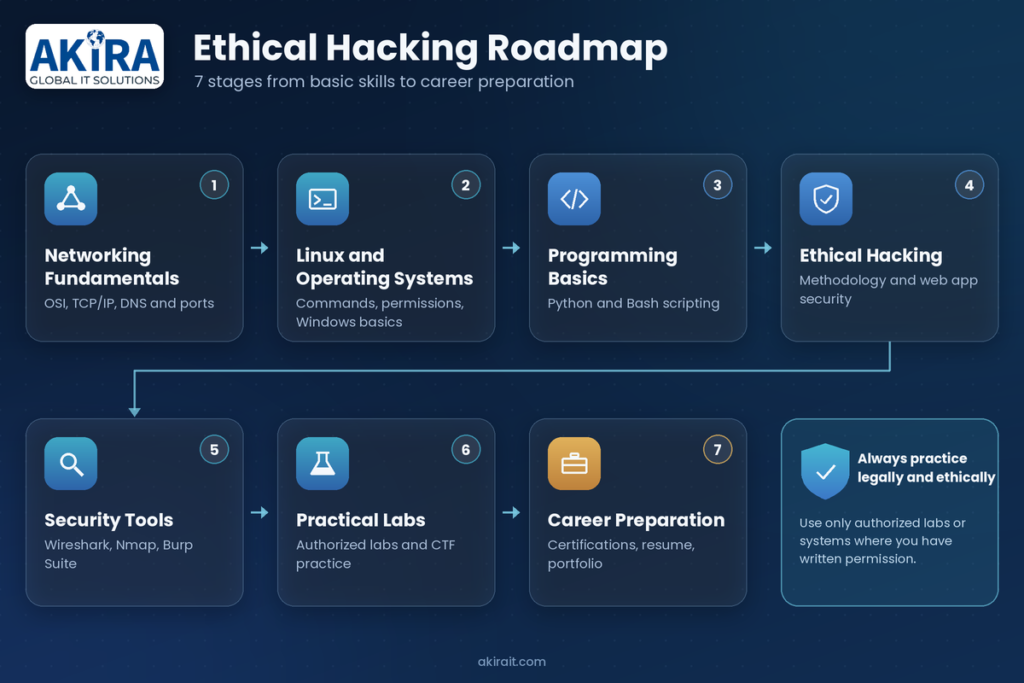
Ethical hacking means testing systems with permission to find weaknesses before criminals do. This ethical hacking roadmap keeps the order simple:
- Learn networking fundamentals. Study ports, protocols, and traffic flow.
- Understand Linux and operating systems. Get comfortable in a terminal.
- Learn scripting basics. Start with Python or Bash.
- Understand web application security. Study the OWASP Top 10 and secure coding principles.
- Study ethical hacking methodology. Reconnaissance, scanning, exploitation, and reporting form the usual cycle.
- Explore cybersecurity tools. Try Wireshark, Nmap, and Burp Suite Community Edition.
- Practice in authorized labs. Use intentionally vulnerable machines and legal capture-the-flag platforms.
- Build projects and document your learning. Write short lab reports or a blog.
- Explore certifications. Compare cybersecurity certifications such as CompTIA Security+ and CEH on their official sites.
Each step supports the next. A cyber security career for beginners grows through layered practice, not a single course or tool. If a stage feels difficult, return to the previous one before moving on.
Ethical hacking roadmap for beginners infographic showing seven learning stages
Always test only systems you own or have written permission to assess. Unauthorized access is illegal, including under India’s IT Act, and ethical hackers work within a defined scope and rules of engagement. Responsible disclosure, meaning reporting a weakness privately to its owner, is part of the same professional habit.
How to Become a Cybersecurity Analyst
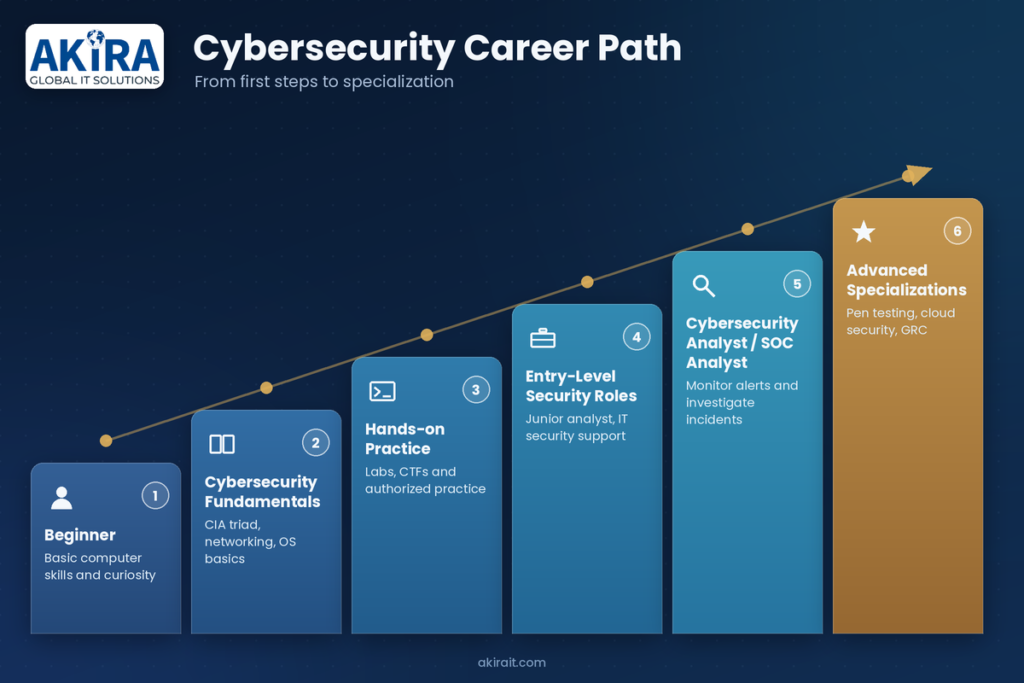
If you are asking how to become a cybersecurity analyst, follow this practical sequence:
- Build an educational foundation. A degree in IT or computer science helps, but self-study and structured training can also work.
- Master the technical core. Networking, operating systems, and security concepts come before advanced tools.
- Learn security tools and platforms. Practice with a SIEM such as Splunk Free or the ELK stack, plus Wireshark and vulnerability scanners.
- Get hands-on. Complete home labs, incident simulations, and capture-the-flag challenges.
- Prepare for certifications. Security+ is a common baseline; check CompTIA for the current exam version.
- Target entry-level roles. Search for SOC analyst, IT security associate, or junior analyst openings, and consider helpdesk routes.
- Prepare your resume and portfolio. Show labs, tools, and clear write-ups of what you investigated.
Cybersecurity career path infographic from beginner to advanced specializations
Your portfolio does not need to be large. Two or three well-documented labs, such as analyzing a phishing sample, reviewing a packet capture, or hardening a virtual machine, tell employers more than a long list of tools.
Before applying, you should be able to explain a packet capture, read system logs, describe the incident response lifecycle, and write a short incident summary.
How to Choose the Right Cyber Security Courses in India
The number of cyber security courses India learners can choose from keeps growing, so evaluate them carefully. A strong program should teach concepts first, then reinforce them with practice:
- Curriculum: Does it cover networking, systems, web security, and security operations?
- Practical labs and projects: Look for isolated lab environments and a capstone.
- Trainer expertise: Ask about real experience in SOC or ethical hacking.
- Beginner-friendly structure: The pace should suit people without a technical background.
- Industry-relevant tools: Wireshark, Nmap, Burp Suite, and a SIEM are good signs.
- Certification preparation: Check which certifications the content maps to.
- Legal and ethical coverage: Offensive topics should begin with law and authorization.
- Career guidance: Confirm exactly what support is offered, without assuming job promises.
A well-designed cyber security training course should let you verify these points on its syllabus page before you pay.
Common Mistakes Beginners Should Avoid
Most setbacks in a cyber security career for beginners come from avoidable habits.
- Skipping networking fundamentals, which makes every later topic harder to understand.
- Learning tools without concepts. Knowing which button to click is not the same as understanding the attack or the defense.
- Relying only on theory. Security is a practical skill, so reading alone leaves gaps.
- Ignoring hands-on practice. Regular lab time builds the confidence interviewers look for.
- Expecting immediate employment. Build skills and a portfolio first, and treat the job search as a process.
- Practicing on systems without permission. This can be illegal and can end a career before it begins.
Start Your Cybersecurity Learning Journey with Akira Global Technologies
Akira Global Technologies is an IT solutions and training company that offers courses across areas such as cloud, DevOps, data, AI, automation testing, and cybersecurity. Its Cybersecurity Training Course is listed as a 60-hour, instructor-led program for freshers, students, career switchers, and IT professionals, with basic computer literacy as the prerequisite.
According to the course page, the syllabus covers networking, system security, web application security, ethical hacking basics, security operations, cloud security, and GRC. About 60 percent of the program is hands-on, using isolated virtual labs and tools such as Wireshark, Nmap, Burp Suite, and Splunk Free or ELK. Learners also complete a team-based capstone, and the course includes career guidance and a certification roadmap. Please confirm current batches and fees with the admissions team.
Beyond cybersecurity, Akira also offers software development, AI solutions, staffing, and corporate training, so learners who later want adjacent skills, such as cloud or DevOps, can explore related programs. For anyone planning a cyber security career for beginners, a structured path with labs and clear ethics rules can shorten the guesswork.
Summary: Your Cybersecurity Career Roadmap for 2026
- A cyber security career for beginners is open to students, graduates, and career switchers.
- Start with networking, Linux, Windows, and basic scripting.
- Follow an ethical hacking roadmap, and practice only in authorized labs.
- Aim for entry-level roles such as SOC analyst, then specialize.
- Choose courses with labs, ethics coverage, and transparent outcomes.
- Build a portfolio, document your learning, and keep your expectations realistic.
Frequently Asked Questions
- Can beginners start a career in cybersecurity without experience?
Yes, beginners can start without prior experience. Begin with networking, operating systems, and security basics, then practice in labs. Many people enter through IT support or helpdesk roles. A structured learning plan makes a cyber security career for beginners far more achievable.
- How long does it take to learn cybersecurity from scratch?
It depends on your background and study time, but most beginners need several months of steady effort to build job-relevant fundamentals, and advanced specializations take longer. Consistent weekly practice matters more than speed. Treat learning as ongoing, because tools and threats keep changing.
- Is ethical hacking a good career option for beginners?
Ethical hacking for beginners can be rewarding, but it is rarely the first job. Many penetration testers begin in networking, development, or SOC roles. Build fundamentals first, practice only in authorized labs, and treat it as a specialization to grow into.
- How can I become a cybersecurity analyst in India?
Learn networking, Linux, Windows, and security fundamentals, then practice with tools such as Wireshark and a SIEM. Add a recognized certification if suitable, build a lab portfolio, and apply for SOC, helpdesk, or junior security roles in Indian companies.
- Which cybersecurity skills should beginners learn first?
Start with networking fundamentals, then Linux and Windows basics. Next, add scripting with Python or Bash and core security concepts like the CIA triad. These skills support nearly every cybersecurity role, from analyst to ethical hacker.