There is no universal winner in React vs Angular vs Vue, but there is a sensible default. For most learners who want the widest range of job options, React is the safest first choice. Angular suits structured enterprise work, and Vue offers the gentlest start. This guide compares all three using official documentation and the latest developer surveys.
Choosing matters because a framework takes months to learn well, and your first portfolio projects will be built on it. React, Angular and Vue all solve the same problem: building interactive user interfaces from reusable components. They differ in how much structure they impose and how much they leave to you.
At Akira Global Technologies, React sits in the Java Fullstack training program, while the company’s website lists React, Angular and Node.js among the application development technologies it works with. That mix reflects what many teams actually use, so this comparison focuses on practical decisions rather than fan debates.
A note on versions: frameworks release updates often, so always confirm the current version and support status on each official site before you start a project.
Quick Summary: React vs Angular vs Vue
| Goal | Best fit | Reason |
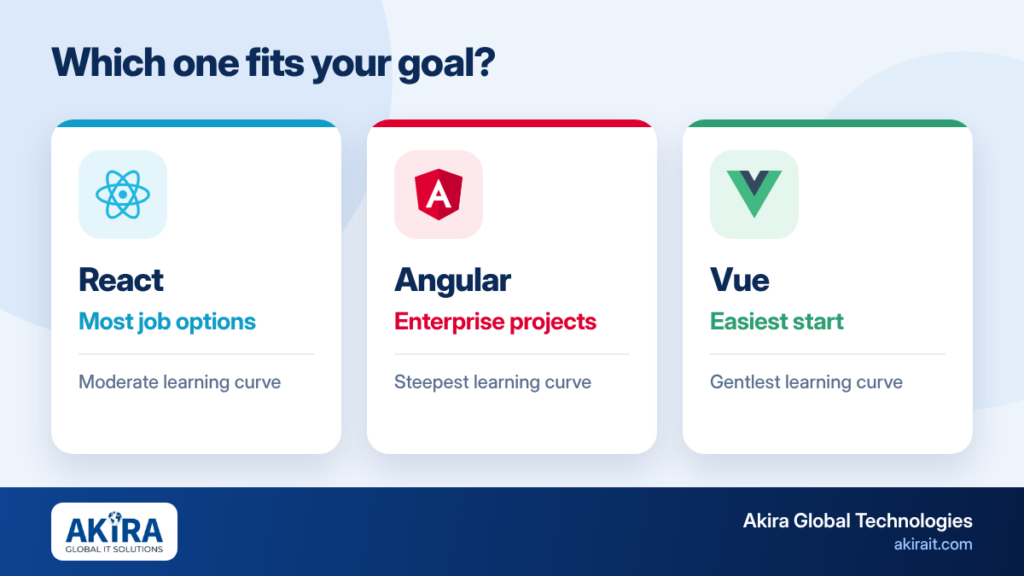
| Easiest start | Vue | Template syntax close to plain HTML, with a gradual path |
| Flexible development and most job options | React | Largest usage and ecosystem, per the latest surveys |
| Structured enterprise applications | Angular | Router, forms, HTTP and testing tools come built in |
Before choosing, consider: your target employers, your comfort with TypeScript, and whether you prefer freedom or conventions.
Learning recommendation: learn JavaScript and TypeScript first, then React. Add Angular or Vue later if your job or project asks for it.
What Are React, Angular and Vue?
React, Angular and Vue are JavaScript tools for building user interfaces from components. React is a library, Angular is a full framework, and Vue is a progressive framework that you can adopt in steps.
React
React was created at Meta and is now stewarded by the independent React Foundation. It focuses on the view layer and leaves routing and data fetching to other tools or to frameworks such as Next.js. React 19 is the current major line, and react.dev publishes the full version history.
It suits learners who want maximum job exposure and teams that want to choose their own tools.
Angular
Angular is built by Google and written in TypeScript. It ships with routing, forms, an HTTP client and a command-line tool, so projects look similar across teams. Angular follows a predictable release schedule, and angular.dev lists each version’s active and long-term support windows.
It suits developers heading into large organisations that value consistency.
Vue
Vue was created by Evan You and is maintained by a core team and community. Its single-file components keep template, logic and styles together. The stable line is Vue 3.5, while Vue 3.6 with the optional Vapor Mode compiler was still at release-candidate stage at the time of writing, per the vuejs/core releases.
It suits beginners, solo developers and small teams who want quick results with little ceremony.
React vs Angular vs Vue: Key Differences at a Glance
| Factor | React | Angular | Vue |
| Backed by | Meta origins, React Foundation | Independent core team | |
| Type | UI library | Full framework | Progressive framework |
| Architecture | Components, hooks, JSX | Components, services, dependency injection | Components, Composition API, single-file components |
| Language | JavaScript or TypeScript | TypeScript | JavaScript or TypeScript |
| Learning curve | Moderate | Steepest | Gentlest |
| Performance | Fast; React Compiler automates memoization | Fast; signals and zoneless support | Fast; Vapor Mode in 3.6 release candidates |
| Flexibility | Very high | Opinionated | High |
| TypeScript support | Strong | Built in and expected | Strong |
| Ecosystem | Largest | Cohesive, official | Focused, official core libraries |
| Community | Largest | Large, enterprise heavy | Active, strong in Asia and Europe |
| Scalability | High with good conventions | High by design | High with good conventions |
| Best use cases | Product apps, startups, mixed teams | Enterprise portals, large teams | Dashboards, small and mid apps |
React vs Angular vs Vue: Detailed Comparison
React vs Angular vs Vue: Learning Curve
Vue is usually the quickest to learn, React comes next, and Angular takes the longest because it asks you to learn a whole platform at once.
Vue lets you start with HTML-like templates. React needs comfort with JavaScript functions, state and hooks. Angular adds TypeScript, decorators, dependency injection and RxJS-style thinking. None is hard after a month of steady practice, but Angular front-loads more concepts.
React vs Angular vs Vue: Performance
For typical business apps, all three are fast enough that your code matters more than your choice. Differences show up in how each reduces unnecessary work.
React Compiler is now stable and automates memoization. Angular has moved toward signals and zoneless change detection. Vue’s Vapor Mode, still in release candidates at the time of writing, compiles components to direct DOM updates. Treat benchmark claims with care and measure your own app.
React vs Angular vs Vue: Architecture and Flexibility
React gives you components and lets you assemble everything else. That freedom is useful and also the source of its biggest beginner problem: too many choices.
Angular decides for you. A new Angular developer can usually read an unfamiliar Angular codebase quickly, because folder structure and patterns are consistent. Vue sits between the two, with official routing and state libraries but fewer rules.
React vs Angular vs Vue: Developer Experience
Vue is often praised for clear error messages and readable single-file components. Angular’s command-line tool generates code and enforces structure. React’s experience depends on the stack around it, such as Vite or Next.js.
The State of JS survey notes that React tops the list of pain points developers mention, partly because it is the most widely used. Dominance brings visibility, and visibility brings criticism.
React vs Angular vs Vue: Ecosystem and Community
In the latest Stack Overflow Developer Survey, across all respondents worldwide, React was used by 44.7%, Angular by 18.2% and Vue by 17.6%. The State of JS survey reports that front-end usage rankings have stayed remarkably stable year over year.
A bigger ecosystem means more tutorials, libraries and answered questions. It also means more fragmentation to navigate.
React vs Angular vs Vue: Scalability and Enterprise Applications
All three scale when teams follow conventions. Angular enforces them, which helps large teams with high turnover. React and Vue need written team standards, linting and code review to reach the same consistency.
A practical example: a bank building an internal portal with 40 developers will often value Angular’s uniform structure. A startup shipping a customer-facing product with six developers may prefer React’s hiring pool.
Which Is the Best JavaScript Framework?
The best JavaScript framework depends on your goal. React fits breadth of opportunity, Angular fits structured enterprise work, and Vue fits fast, approachable development.
When React is a suitable choice: you want the most job exposure, plan to use Next.js or React Native, or work in a team that likes choosing its own tools. The limitation is decision fatigue and a fast-moving ecosystem.
When Angular is a better choice: you are targeting enterprise, banking, insurance or government projects, or you already know TypeScript and object-oriented design. The limitation is the steeper start and a smaller share of job posts in many markets.
When Vue is worth considering: you want a calm learning experience, you are building small or mid-sized products, or you freelance. The limitation is a smaller hiring pool in some regions.
Beginners: Vue is easiest, but React is the better long-term bet for most.
Large-scale applications: Angular’s structure is the most predictable, though React with strict standards works well too.
Expect the future to be an evolution rather than a revolution. Angular publishes its release roadmap on angular.dev, and Vue’s Vapor Mode may reach stable status. These are expectations, not guarantees.
React vs Angular vs Vue: Career Opportunities
React has the broadest demand signal in public data, because developer usage and ecosystem size both favour it. That does not mean Angular and Vue lack jobs. It means competition and opportunity are distributed differently.
Startups versus enterprise: startups and product companies commonly choose React. Large enterprises and service companies often maintain Angular applications, and Vue appears in mid-sized teams and agencies. Check live job listings in your city to see the real mix.
What employers generally expect: solid JavaScript, TypeScript, Git, REST API integration, component testing and the ability to explain your project decisions. Framework knowledge alone rarely carries an interview.
Full-stack paths: front-end skills combined with a backend. If you are weighing Java or JavaScript on the server, read Akira’s comparison of Spring Boot vs Node.js. Many learners in India pair React with Spring Boot, which is the exact pairing in the Java Fullstack program on the Akira Global Technologies site.
Salary and hiring numbers change by city and year, and this guide does not quote any. Use recent regional job boards and company career pages instead.
Which Framework Should Beginners Learn?
Most beginners should learn React after JavaScript, unless they are targeting Angular-heavy employers or want the easiest possible start with Vue.
| Your situation | Recommended path | Why |
| Student | React, or Vue first if you struggle | Broad opportunities, many learning resources |
| Fresher seeking first job | React with TypeScript | Common in entry-level listings and portfolios |
| Career switcher | React or Vue | Quicker to build visible projects |
| Backend developer moving to frontend | Angular if you know Java or C#; otherwise React | Angular’s structure feels familiar |
| Experienced developer upgrading | Match your team’s stack, then add React | Fastest route to impact |
For example, a fresher who builds a service request portal with React and a REST API shows more than one who completes ten isolated tutorials. For ideas that pair well with a frontend, see Akira’s guide to Java projects for beginners.
What Should You Learn Alongside React, Angular or Vue?
Learn JavaScript fundamentals first, then HTML5, CSS3, Git, TypeScript, REST APIs and testing. These skills transfer between frameworks and make every framework easier.
Frameworks change faster than the language beneath them. If you understand closures, promises and array methods, a new framework takes weeks, not months. MDN Web Docs remains the most reliable reference for these basics.
- HTML5 and CSS3: semantic markup, accessibility and Flexbox or Grid.
- JavaScript fundamentals: scope, async code, modules and the DOM.
- TypeScript: the latest State of JS survey reported that around 40% of respondents write only TypeScript.
- Git and GitHub: branching, pull requests and readable commit messages.
- REST APIs: fetching, error handling and authentication basics.
- Responsive design: mobile-first layouts.
- Testing: unit tests for components and one end-to-end flow.
- Basic backend knowledge: enough to read an API contract and debug a request.
Akira’s Java Fullstack syllabus follows this order. Its React module covers HTML, CSS, modern JavaScript and async code before it reaches components, state and routing.
FAQs
1. Which is better: React, Angular or Vue?
None is better in every case. React offers the widest ecosystem and job exposure, Angular gives enterprise teams a consistent structure, and Vue is the easiest to start with. Pick based on your target employers and learning style, then go deep in one framework before adding another.
2. Which frontend framework is easiest to learn for beginners?
Vue is generally the easiest, because its templates resemble plain HTML and it can be adopted gradually. React is a close second once you know JavaScript functions. Angular is the hardest at first because it introduces TypeScript, dependency injection and many built-in tools together.
3. Is React more in demand than Angular and Vue?
Public data points that way. In the latest Stack Overflow Developer Survey, React had higher usage than Angular and Vue among all respondents. Usage is not the same as job openings, so compare listings in your own city and industry before deciding.
4. Should I learn React or Angular for a frontend developer career?
Choose React for breadth, startups and product companies. Choose Angular if you target enterprise employers or already know TypeScript and object-oriented programming. If you are unsure, learn React first, since its component ideas make Angular and Vue easier to pick up later.
5. Can I get a job by learning React, Angular or Vue?
It can help, but a framework alone does not guarantee a job. Employers also look for JavaScript depth, TypeScript, Git, API skills and finished projects. Build two or three portfolio apps, practise explaining your code, and keep your resume focused on what you built.
Final Verdict: React vs Angular vs Vue, Which One Should You Choose?
Choose React if you want the most flexibility and job exposure. Choose Angular if you are aiming for structured enterprise work and are comfortable with TypeScript. Choose Vue if you want the smoothest learning curve or work on smaller products.
Whatever you pick, spend your first month on JavaScript and your next two building real projects. Depth in one framework beats shallow knowledge of three.
If you want guided practice, Akira Global Technologies publishes career guides such as its software developer resume tips and runs a Java Fullstack program with React and Spring Boot projects. Compare the syllabus with your own goals before you decide.