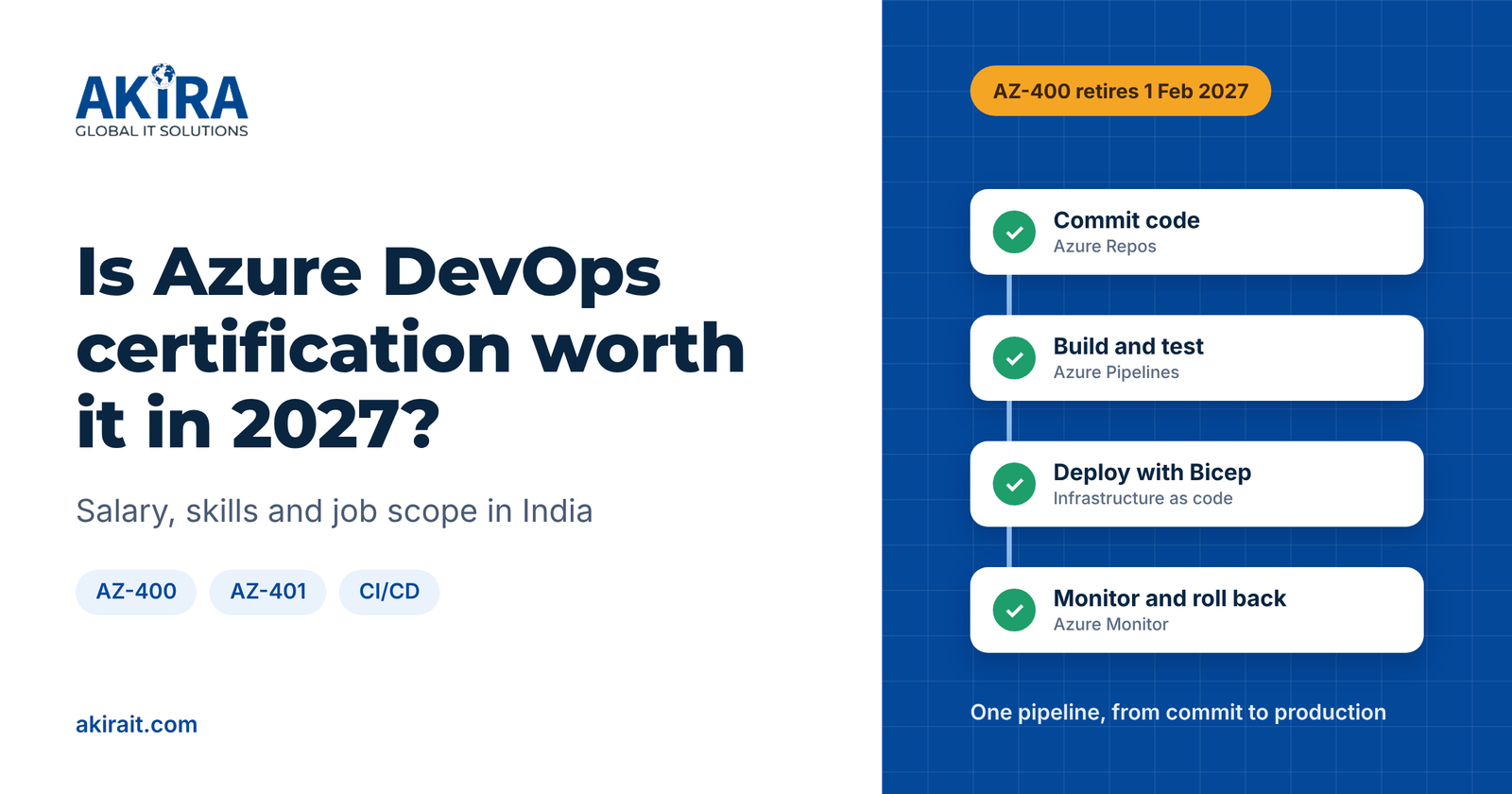
Yes, for most people it is worth it, provided you pair it with hands-on pipeline practice. An Azure DevOps certification gives employers a recognised signal that you can design and run CI/CD on Microsoft’s stack, but it does not guarantee a job. One timing note: Microsoft will retire the AZ-400 exam on 1 February 2027 and replace it with AZ-401, so check which route fits your schedule. Research time: November 2026.
Teams no longer release software once a quarter. Banks, retailers and SaaS companies ship updates weekly or daily, which only works when building, testing, securing and deploying code is automated. That is the daily work of a DevOps engineer, and Azure is a common platform for it. A well-chosen azure devops certification helps you prove you understand the full workflow, from Git branching to infrastructure as code. This guide from Akira Global Technologies covers the exam route, skills, salary, job scope and the limits of certification.
What Is Azure DevOps Certification?
Azure DevOps is Microsoft’s platform for planning, building and delivering software. It combines Azure Repos, Azure Pipelines, Azure Boards, Azure Test Plans and Azure Artifacts.
Knowing these tools is not the same as holding a certification. Running a build in Azure Pipelines is a skill. A Microsoft DevOps certification is a proctored credential showing you can design the whole delivery process, including source control, pipelines, security and monitoring. The current credential is Microsoft Certified: DevOps Engineer Expert, often searched as the devops azure certification. It is an Expert-level award, so Microsoft expects you to hold an associate-level Azure certification first.
Which Azure DevOps Certification Should You Pursue in 2027?
The current route: DevOps Engineer Expert and AZ-400
You earn it by passing Exam AZ-400: Designing and Implementing Microsoft DevOps Solutions and holding either Azure Administrator Associate (AZ-104) or Azure Developer Associate. The pass mark is 700 out of 1,000, and renewal is free through an online assessment on Microsoft Learn each year. Microsoft lists associate and expert exams at about USD 165 in the US, and shows local pricing when you choose India on the exam page. The Developer Associate exam (AZ-204) retired on 31 July 2026, although a Microsoft Learn Q&A reply says earning it before that date still satisfies the prerequisite.
What changes in February 2027
On 15 October 2026, Microsoft announced that AZ-400 and DevOps Engineer Expert will retire on 1 February 2027. The successor is Microsoft Certified: Agentic DevOps Engineer Expert, earned through Exam AZ-401, which was in beta at the time of writing, with general availability expected in December. You also need AZ-104 or GH-300 (GitHub Copilot). The exam still covers pipelines, source control, security and monitoring across Azure DevOps and GitHub, and adds AI-assisted work such as Copilot, MCP servers and agentic workflows. Microsoft expects practical YAML, KQL and Bicep skills.
Who should consider it?
- Developers and system administrators moving into automation
- Cloud engineers who already hold AZ-104
- Build and release engineers who want formal validation
If you are new to Azure, start with fundamentals and AZ-104, which counts toward both routes. Confirm the exam status on Microsoft Learn before you book.
Azure DevOps certification cost is more than the exam fee. Budget for a practice environment (a free or low-cost Azure subscription is usually enough), study material, and a retake if needed, because a failed attempt means paying the exam fee again. Many learners spend more on azure devops training than on the exam itself, so compare syllabus depth and lab access before paying for any course.
What Skills Do You Learn Through Azure DevOps Training?
Good azure devops training goes well beyond clicking through the portal. Expect to learn:
- Git and Azure Repos: branching strategies, pull requests and branch policies that protect main code.
- Azure Pipelines and YAML: reusable pipeline definitions stored alongside the code.
- CI/CD pipeline implementation: automated build, test and release stages with approvals.
- Azure Boards: tracking work items and linking them to commits and releases.
- Azure Test Plans: manual, exploratory and automated test management.
- Azure Artifacts: private package feeds for internal libraries.
- Infrastructure as Code: defining environments with Bicep, ARM templates or Terraform.
- Monitoring and deployment automation: Azure Monitor, alerts and rollback strategies.
- DevSecOps fundamentals: secret, dependency and code scanning inside the pipeline.
In a real project these pieces connect. A developer opens a pull request for a retail checkout service, the pipeline runs tests and a security scan, deploys test infrastructure defined in Bicep, and waits for approval before a gradual production release. Azure Monitor then watches the release and can trigger a rollback.
Azure DevOps Engineer Salary in India in 2027
Here is what verified data shows. As of June 2026, Glassdoor India reports an average of about ₹9.65 lakh for DevOps Engineers, based on 15,085 submissions, with a typical range of ₹5.15 to ₹13.73 lakh. For Cloud DevOps Engineers, Glassdoor’s average is ₹7.9 lakh, with the 90th percentile near ₹19.8 lakh. AmbitionBox company pages for Azure DevOps Engineers show wide spreads, such as ₹4.5 to ₹11.6 lakh at TCS for 2 to 8 years of experience (updated 2025). I found no source publishing official 2027 figures, so the last column below is an estimate.
| Experience level | Verified data (2023 to 2026) | Estimated 2027 range |
| Freshers | Little reliable data; a 2023 AmbitionBox estimate was ₹3.2 to 4 lakh | ₹3.5 to 6 lakh |
| 1 to 3 years | Glassdoor submissions vary from about ₹2 to 13 lakh | ₹5 to 10 lakh |
| 3 to 5 years | AmbitionBox company pages show about ₹4.5 to 13.8 lakh | ₹8 to 15 lakh |
| 5 to 8 years | Glassdoor submissions for 4 to 9 years run from about ₹7 to 27 lakh | ₹13 to 24 lakh |
| 8+ years | Small samples, roughly ₹11 to 20 lakh at 10 to 14 years, with higher outliers | ₹20 to 35 lakh |
These estimates assume flat to modest growth and are my planning ranges, not forecasts from any source. Pay depends less on the certificate than on technical depth, cloud and Infrastructure as Code experience, city (metro hubs such as Bengaluru often pay more), employer type, and project exposure such as Kubernetes or multi-cloud work.
Job Opportunities and Career Scope After Azure DevOps Certification
Azure DevOps career opportunities cover several overlapping job roles:
- Azure DevOps Engineer: builds and maintains pipelines, repos and release processes for application teams.
- DevOps Engineer: handles broader automation, often including Docker, Kubernetes and Terraform.
- Cloud DevOps Engineer: combines cloud infrastructure with delivery pipelines and cost control.
- Build and Release Engineer: owns build servers, versioning and release schedules.
- CI/CD Engineer: specialises in pipeline design, speed and reliability.
- Site Reliability Engineer (SRE): focuses on uptime, monitoring and incident response, using scripting and KQL.
- Cloud Automation Engineer: automates provisioning and operations through code.
Demand tends to follow how many companies are automating releases and moving workloads to the cloud, and Azure shows up often in enterprise environments that already run Windows Server, Microsoft 365 or .NET applications. I could not find an official count of Azure DevOps openings for 2027, so treat any claim of a precise hiring surge with caution. The more reliable signal is the job description itself: search current listings for the role titles above and note which tools, such as Terraform, Kubernetes and GitHub Actions, appear alongside Azure Pipelines.
IT services and consulting firms such as TCS, Infosys and Accenture appear often in salary listings, and banking, healthcare, retail and telecom organisations that run Microsoft stacks also hire for these roles.
Is Azure DevOps Certification Worth It for Freshers?
It can help, but it is rarely enough. The Expert exam assumes professional experience that freshers usually lack. Hiring managers for junior roles commonly look for Linux, Git, networking basics and a scripting language. A fresher is better served by AZ-900 and AZ-104, followed by two or three pipeline projects. At this level, employers expect you to explain a pipeline you built, fix a failing deployment and write simple Bash or PowerShell. Before chasing advanced credentials, a good cloud computing training course covering virtual machines, networking and storage will make DevOps concepts far easier to absorb.
Is Azure DevOps Certification Worth It for Experienced IT Professionals?
For system administrators, developers and cloud engineers, certification works as validation of skills you already use. An administrator who has scripted deployments can formalise that knowledge, while a developer gains a structured view of release engineering and security. It can support a move into DevOps, SRE or platform roles, and it helps in appraisals and client-facing consulting work where a Microsoft credential carries weight. The benefit is smaller if you already have well-documented project experience and your target employers do not ask for Azure credentials.
A practical test: scan five job descriptions for the role you want. If most mention Azure Pipelines, Azure DevOps or a Microsoft credential, the certification is a direct match. If they ask mainly for Jenkins, AWS or Kubernetes, your time may be better spent there first.
Azure DevOps vs AWS DevOps vs Google Cloud DevOps
Each cloud has native tooling, but the core DevOps ideas carry across. A broader AWS vs Azure vs GCP comparison is useful context before you pick a specialisation.
| Azure | AWS | Google Cloud | |
| Native CI/CD tools | Azure Pipelines, Repos, Boards | CodePipeline, CodeBuild, CodeDeploy | Cloud Build, Cloud Deploy |
| Infrastructure as Code | Bicep, ARM, Terraform | CloudFormation, CDK, Terraform | Terraform, Infrastructure Manager |
| Commonly strong fit | Microsoft-centric enterprises, .NET, hybrid setups | Wide range from startups to large enterprises | Data, analytics and Kubernetes-focused teams |
| DevOps certification | DevOps Engineer Expert (AZ-400), moving to AZ-401 | AWS Certified DevOps Engineer Professional | Professional Cloud DevOps Engineer |
No platform is universally better. Many teams also run GitHub Actions or Jenkins across clouds, and skills in Git, Docker, Kubernetes and Terraform transfer to all three.
How to Prepare for Azure DevOps Certification in 2027
- Learn Azure fundamentals. Start with AZ-900 concepts, then AZ-104, since it counts toward both the old and new routes.
- Master Git and version control. Practise branching, merging and resolving conflicts until they feel routine.
- Practice CI/CD pipelines. Write YAML pipelines, then deliberately break them and fix them.
- Work on real projects. Deploy a small web app to Azure with Bicep, staging and production environments, and approvals.
- Prepare for the exam. Use the official study guide and practice assessment on Microsoft Learn for AZ-400 or AZ-401, and check what is available for the beta.
- Choose structured resources. Free Microsoft Learn paths work well. Whether you add Akira Global Technologies or another provider, azure devops training online is useful only if it includes real labs and mentor feedback.
- Build a portfolio. Publish a GitHub repository with pipelines, architecture diagrams and a clear README.
Is Azure DevOps Certification Alone Enough to Get a Job?
No. A certificate shows you studied the material; employable skills show you can apply it under pressure. Recruiters typically look for hands-on pipeline work, troubleshooting ability when a deployment fails, scripting in PowerShell or Bash, comfort with Linux and networking, and a clear grasp of cloud basics. Interviews often include scenarios such as rolling back a failed release or securing secrets in a pipeline. Certification can get your resume noticed, while projects and clear explanations carry the interview.
Think of it this way: the exam proves you know what a branch policy or a deployment strategy is, while a portfolio proves you have configured one and dealt with the consequences. Candidates who can show both are usually in the strongest position.
Final Verdict: Should You Invest in Azure DevOps Certification in 2027?
It is worth it for IT professionals with some Azure exposure, for developers and administrators moving into automation, and for anyone targeting Microsoft-centric employers. It is less useful for complete beginners without cloud basics, and for anyone expecting the credential alone to deliver a salary jump. Pair it with Git, YAML, Bicep or Terraform, scripting and at least two portfolio projects. Given the AZ-401 transition, plan your exam timing carefully and confirm details on Microsoft Learn. If you want guided practice, a learning partner such as Akira Global Technologies can offer structured labs and mentoring, but judge any programme by its hands-on content rather than its marketing.
Frequently Asked Questions
1. Is Azure DevOps certification worth it in 2027?
Yes, if you pair it with practical experience. It signals structured Azure and CI/CD knowledge, which helps with shortlisting, but it does not replace projects or guarantee a job. AZ-400 retires on 1 February 2027, so confirm whether you will sit AZ-400 or the new AZ-401 before investing in study material. Guided, lab-based training from providers such as Akira Global Technologies can help you build that hands-on experience.
2. What is the salary of an Azure DevOps engineer in India?
Public data shows wide ranges. Glassdoor listed an average of about ₹9.65 lakh for DevOps Engineers in India in June 2026, with a typical range of ₹5.15 to ₹13.73 lakh. Experience, city and employer matter more than the certificate. The 2027 figures in this article are estimates, not official numbers.
3. Is Azure DevOps certification suitable for freshers?
It can be, but it is not the best first step. Start with Azure fundamentals, Linux, Git and scripting, then add AZ-104 and a few pipeline projects. The Expert credential assumes professional experience, so freshers usually gain more from hands-on projects than from rushing straight to AZ-400 or AZ-401.
4. How difficult is the Microsoft Azure DevOps Engineer certification?
It is an expert-level exam, so it is demanding. Microsoft expects strong Azure administration or development skills plus hands-on YAML, KQL and Bicep. Scenario questions reward practical experience over memorisation. The pass mark is 700 out of 1,000, and regular practice with real pipelines helps more than reading alone.
5. Can I get a DevOps job after completing Azure DevOps training online?
It is possible, but training alone rarely closes the gap. Choose azure devops training online that includes real labs, build a public portfolio of pipelines and projects, and practise explaining your troubleshooting steps. Employers hire for demonstrated skills, so the certificate works best as supporting evidence rather than your main selling point.