
The best IT course is the one that matches your current skill level, points towards a role you genuinely want, and teaches through live practice instead of slides alone. For most learners, cloud computing, DevOps, data analytics, data science, cybersecurity and AI are the strongest areas to compare first, because companies across industries keep building teams around these skills.
That answer sounds simple, but choosing is rarely easy. A quick search returns hundreds of options, and almost every one claims to be the best. Some suit complete beginners, others assume years of experience, and many look identical on a brochure. This guide explains how to judge a programme properly, which fields deserve your attention in 2027, what other learners are searching for, and how to match a course to your own situation, whether you are a fresher, a working professional or someone changing careers.
Quick Summary
- The best IT course fits your starting point, aims at a specific role and includes live practice and projects.
- Cloud, DevOps, data (analytics and data science), cybersecurity and AI are strong domains to compare first. Confirm demand with current job listings.
- Freshers should build broad foundations, professionals should move into adjacent skills, and career switchers should commit to one domain.
- AI assistants are useful for shortlisting courses, but verify fees, trainers and syllabi with the provider.
- Before enrolling online, check tools, batch size, recordings, demo access and clear fee terms.
- Treat any job or salary guarantee as a warning sign.
What Makes the Best IT Course for You?
A good IT course does three things well. It teaches skills that appear in real job descriptions, it gives you a working environment to practise those skills, and it puts you in front of trainers who have done the job themselves.
Use this checklist to judge any programme:
- Relevant syllabus: Topics should reflect the tools and workflows employers use today, not versions that were popular five years ago.
- Hands-on labs and projects: Reading about a deployment is very different from running one. Look for assignments you complete yourself.
- Trainer experience: Ask whether the trainers have worked in the field they teach.
- Live interaction: Asking questions during a session shortens the time you stay stuck on a problem.
- Revision support: Recordings, notes and doubt-clearing sessions help when you miss a class or want to revisit a topic.
- Honest career support: Resume reviews and mock interviews are useful, as long as the provider is clear that no course can guarantee a job.
No single factor decides the outcome. A course with a perfect syllabus but no practice leaves you with theory and little confidence, while a project-heavy course with an outdated syllabus teaches habits you will have to unlearn later.
Top IT Courses to Consider in 2027
Top IT courses cluster around a handful of domains. The table below shows what each domain usually covers and who it tends to suit. Treat it as a starting point for comparison, not a ranking.
| Cloud Computing | Compute, storage, networking and security on platforms such as AWS, Azure and Google Cloud | Freshers, system administrators, developers |
| DevOps | Linux, Git, CI/CD, containers, infrastructure as code, monitoring | Developers, administrators and testers moving into engineering roles |
| Data Analytics | SQL, Excel, Tableau or Power BI, reporting, basic statistics | Graduates, business professionals, non-programmers |
| Data Science | Python, statistics, data visualisation, machine learning basics | Graduates and analysts comfortable with maths and coding |
| Data Engineering | Data pipelines, warehousing, big data tools | Developers and analysts who enjoy building systems |
| Cybersecurity | Network security, threat detection, security fundamentals | Networking and IT support professionals, freshers |
| AI and Machine Learning | Python, model building, evaluation, generative AI tools | Programmers and analysts comfortable with maths |
| Full Stack Development | Front end, back end and databases in Java, Python or .NET | Freshers who want to build applications |
| Automation Testing | Test frameworks, scripting, CI integration | Manual testers and QA engineers |
| Enterprise Platforms | Salesforce, ServiceNow, SailPoint, Oracle applications | Professionals targeting specific enterprise roles |
Training providers such as Akira Global Technologies offer programmes across most of these domains, including DevOps, cloud computing, data analytics, cybersecurity, AI and machine learning, full stack development, automation testing, Salesforce and ServiceNow. You can browse the full list of IT courses to compare syllabus side by side.
Trending IT Courses and Why Employers Want These Skills
Trending IT courses follow the way companies build and run software. Instead of chasing a buzzword, it helps to understand why each area keeps growing.
Cloud and DevOps
Most organisations now run applications on cloud platforms and release updates frequently. That created steady demand for people who can automate deployments and keep systems stable. Tools such as Docker, Jenkins and Terraform are common in this space, along with Kubernetes, an open source platform for automating the deployment, scaling and management of containerised applications.
AI and Generative AI
Businesses are testing AI in customer support, analytics, content creation and software development. Learners who understand Python, data handling and how models are evaluated are better prepared than those who only know how to use a chatbot.
Data Analytics and Data Engineering
Every team that collects data needs people to clean it, model it and explain it. SQL and a reporting tool such as Power BI or Tableau remain practical entry points for analysts. Data science goes further into Python, statistics and machine learning, and it suits people who enjoy working with numbers. Data engineering suits people who prefer building the pipelines behind those reports.
Cybersecurity
As more work moves online, protecting systems, networks and identities is a continuing need in banking, healthcare, retail and government alike. Beginners can start with networking and security fundamentals before choosing a specialisation.
A trend is a signal, not a promise. Hiring conditions differ by city, company and year, so read current job listings for the roles you want before you commit to a course.
What Are People Searching For? Popular IT Course Queries
Search habits show what learners are curious about, though they do not show what is right for you. Common searches include data science courses, cybersecurity courses, cloud computing courses, data analyst courses, Python for data science, DevOps engineering and AWS training. The table groups these by intent so you can see what to check before enrolling.
| What people search | Example queries | What to check before choosing |
| Domain courses | data science courses, cybersecurity courses, cloud computing courses | Syllabus depth, labs and projects |
| Role-based starts | data analyst courses, Python for data science | Prerequisites and tools taught |
| Cloud and DevOps | AWS training, DevOps engineering, cloud certification courses | Hands-on practice with Linux, Git, Docker and a cloud platform |
| Vendor certificates | AWS, Security+, CEH, Google Cybersecurity | Whether the course prepares you for the exam or only gives a completion certificate |
Search interest is a signal, not a promise. Read current job listings for the role you want before you pick a course, and use a tool such as Google Trends to check how interest in a topic changes over time.
How to Use AI Tools to Shortlist an IT Course
Many learners now ask an AI assistant before they talk to a training provider. It works well for narrowing options, as long as your prompt is specific. Try prompts like these:
- “I am a manual tester with basic SQL. Suggest three IT courses that lead to an automation role and list the skills each one builds.”
- “Compare cloud, DevOps and data analytics for a beginner with no coding background. Which should I start with, and why?”
- “I can study two hours a day for six months. Build a learning plan for DevOps with a project every month.”
- “Which skills in cybersecurity are most useful to practise first, and which tools should I learn?”
- “Give me ten questions to ask a training provider before I pay, covering fees, batch size, recordings and certificate wording.”
Treat the answers as a starting point. AI tools can be out of date on tools, fees and syllabi, so confirm the details with the provider, attend a demo class and check current job listings.
Which Is the Best IT Course for Freshers, Professionals and Career Switchers?
Best IT Course for Freshers
Start where the foundations are broad. Python or Java full stack development, data analytics and cloud fundamentals all give you skills that transfer between roles. Choose a programme that includes projects, because a small portfolio on GitHub gives interviewers something concrete to discuss. Learn Git and basic SQL early, since nearly every technical role uses them.
Best IT Course for Working Professionals
Build on what you already know. A manual tester can move into automation testing, a system administrator into DevOps or cloud, and a developer into data engineering or AI. Adjacent moves are faster than starting from zero, and your existing experience counts in interviews.
Best IT Course for Career Switchers
Switching from a non-technical background is possible but needs patience. Pick one domain, begin with fundamentals and avoid stacking several courses at once. Data analytics and digital marketing tend to have gentler learning curves at the start, while cloud and DevOps need steady practice with Linux and networking basics. Whatever you pick, plan for months of regular practice, not weeks.
Best Online IT Courses: What to Check Before You Enrol
The best online IT courses offer flexibility without losing the guidance of a real classroom. Quality varies widely, so the format matters as much as the topic.
| Factor | Live instructor-led online | Recorded-only |
| Doubt clearing | In real time during the session | Delayed or forum based |
| Pace | Set by the batch schedule | Fully self-paced |
| Accountability | Higher, because sessions are fixed | Depends on your own discipline |
| Best for | Learners who want guidance and feedback | Learners revising topics they already know |
Before paying for any online programme, ask these questions:
- Which tools and versions will I use, and are they current?
- How large are the batches?
- Are recordings available if I miss a session?
- Can I attend a demo class or speak to a trainer first?
- Are the fees, refund terms and certificate details stated clearly?
A provider confident in its teaching will answer these without hesitation. If the answers stay vague, treat that as useful information.
A Practical Example: What a Hands-On DevOps Course Looks Like
DevOps is a set of practices and a working culture that connects software development with IT operations, so teams can build, test, release and monitor software faster and more reliably. It is a good example of a field where practice matters more than theory, because the work happens through tools and pipelines.
The DevOps programme at Akira Global Technologies shows how the checklist above applies in practice. It runs for two months (60 hours), is delivered through live instructor-led online sessions and uses small batches. The syllabus begins with the basics of what is DevOps, covering the software development lifecycle, Agile, the DevOps lifecycle and CI/CD. It then moves into Linux administration, Git and GitHub, AWS cloud fundamentals with a mini project, and automation tools including Jenkins, Docker, Kubernetes, Terraform and Ansible. Learners also get recordings of live classes, resume preparation, interview questions and mock interviews, and receive a certificate on completion. Basic knowledge of Linux and networking is preferred but not mandatory.
Many cloud and DevOps learners also work towards a vendor certification, such as the credentials AWS offers, which are earned by passing a proctored exam. A course builds the skills, but the exam is a separate step, and a certificate carries more weight when you can also demonstrate the work behind it.
Skills Every IT Learner Needs, Whatever the Course
Some skills pay off in every domain, so they are worth building alongside your main subject:
- Linux and command line basics: Servers, cloud machines and containers mostly run Linux.
- Git and version control: Teams use it to collaborate and track changes to code.
- SQL: Useful for analysts, testers, developers and engineers alike.
- Networking fundamentals: Understanding how systems communicate makes troubleshooting far easier.
- Clear communication: Explaining a problem or documenting a fix is part of almost every IT job.
Learning these early makes advanced topics easier to absorb, and it shortens the gap between finishing a course and being useful on a real team.
Common Mistakes When Choosing an IT Course
- Choosing by trend alone. A popular subject you dislike is hard to stay with for months.
- Ignoring prerequisites. Jumping into an advanced programme without the basics leads to frustration and dropped classes.
- Comparing only fees. A cheaper course without labs or trainer access can cost more in lost time.
- Collecting certificates without projects. Employers want evidence that you can do the work, not only that you attended.
- Trusting AI answers blindly. Chatbots can be outdated on tools and fees. Verify with the provider.
- Believing guarantees. No genuine provider can promise a job or a salary. Treat such claims as a warning sign.
How to Choose Your Course in Five Steps
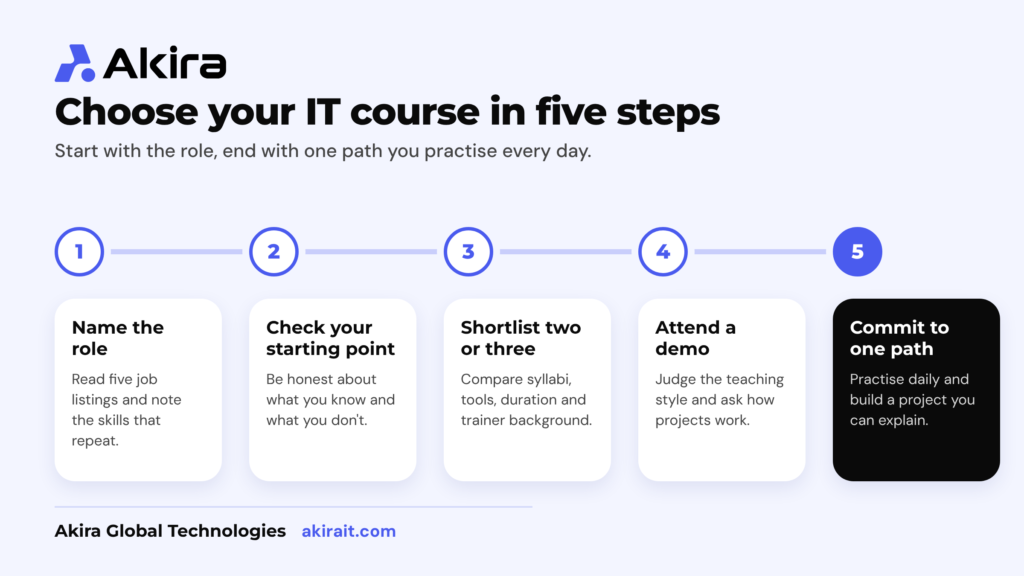
- Name the role you want. Read five job listings and note the skills that repeat.
- Check your starting point. Be honest about what you already know and what you do not.
- Shortlist two or three courses. Compare syllabi, tools, duration and trainer background. An AI assistant can help you draft the comparison.
- Attend a demo or counselling session. Judge the teaching style and ask how projects are handled.
- Commit to one path. Practise daily outside class and build at least one project you can explain from start to finish.
How Professional Guidance Helps
Choosing alone can feel like guessing, especially when you are changing fields. A counselling conversation helps you map your background to a realistic path before you spend time and money. Akira Global Technologies describes its learner journey as starting with a career consultation and a skill assessment before enrolment, followed by live classes, assignments, projects, mock interviews and resume building. Whichever provider you consider, look for that same pattern of guidance first and selling second.
Final Thoughts: Finding the Best IT Course
The best IT course is not a title any provider can award itself. It is a fit between your goals, your current skills and a programme that teaches through practice. Compare domains, check the syllabus, ask about trainers and projects, and stay cautious about guarantees. Akira Global Technologies and other training providers can help you shortlist, but the decision should rest on what you want to do and how consistently you can practise.
If you want a second opinion on your learning path, Get Free Consultation or Contact Us to talk through your goals with the Akira Global Technologies team.
Frequently Asked Questions
- Which is the best IT course for beginners with no coding background?
Data analytics, cloud fundamentals and manual-to-automation testing paths are common starting points because they build gradually. Begin with SQL, Excel or basic Linux, then add a programming language once the fundamentals feel comfortable.
- Which IT course is most popular right now?
Data science, cybersecurity and cloud computing appear often in learner searches, with AI close behind. Popular does not mean right for you, so match the course to your background, your target role and the hours you can practise each week.
- Are the best online IT courses as effective as classroom training?
They can be, when the format includes live instructor-led sessions, hands-on labs and access to trainers. Recorded-only courses work better for revision than for first-time learning, because nobody is available to correct your mistakes.
- Do top IT courses require a degree?
Many programmes accept graduates, working professionals and career switchers from varied backgrounds, but each sets its own prerequisites. Check the eligibility section of the syllabus. Employers may still ask for a degree, so read job listings too.
- Are trending IT courses always the right choice?
Not always. A trending subject helps only if it fits your interests and background. Compare it with the roles you want, read current job listings, and pick the field you can practise consistently for several months.
- Can AI tools choose an IT course for me?
They can help you compare options and build a study plan, but they cannot verify a provider’s trainers, batch size or fees. Use AI to shortlist, then check the syllabus, ask for a demo class and read the certificate terms yourself.
- Should I take a course or go straight for a certification?
A course builds the skills, and a vendor certification such as an AWS credential is a separate exam. Many learners do the course first, then sit the exam once they have practised on real projects.
- How long does it take to become job ready after an IT course?
It varies with the field, your starting point and how much you practise. Some programmes run for a few months, but real confidence comes from projects and repetition. No course can guarantee a timeline or a job offer.