
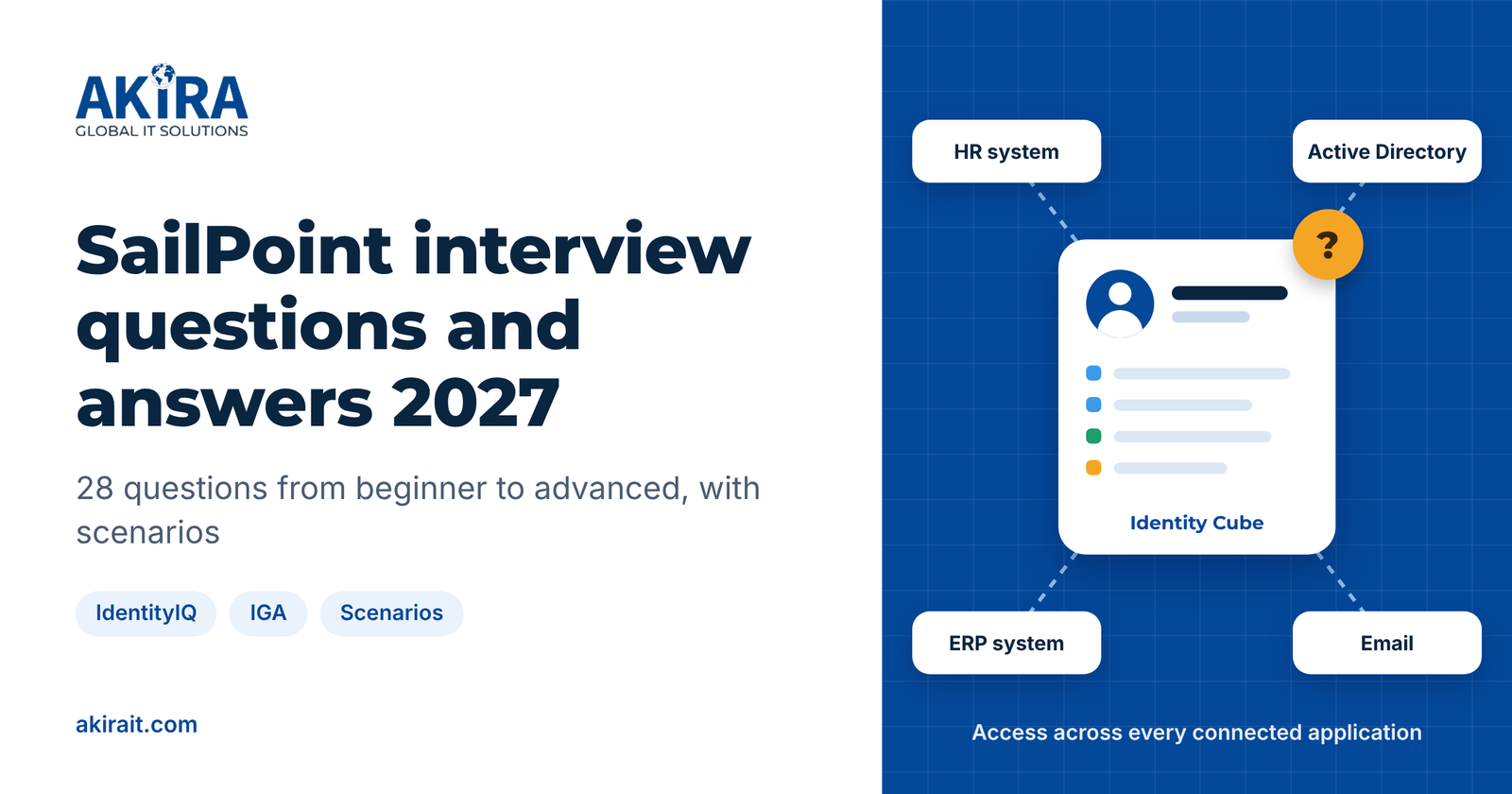
SailPoint interviews test whether you understand how identities, accounts and access are governed in a real enterprise, not just whether you can define terms. Expect questions on identity governance, provisioning, certifications and troubleshooting, with deeper scripting questions for developer roles. This guide from Akira Global Technologies focuses on SailPoint IdentityIQ (IIQ) and suits freshers, IAM engineers and SailPoint developers.
If you are still building your fundamentals, SailPoint training online with hands-on labs can help you practise what these answers describe, and a structured SailPoint course gives you the lab time that reading alone cannot. Whether you pick a SailPoint online course or SailPoint IIQ online training, use this guide to test yourself after each lab. The questions below are common topics, not officially confirmed interview questions, and technical details were checked against SailPoint’s IdentityIQ documentation in November 2026.
What Is SailPoint and Why Is It Important in IAM?
So, what is SailPoint? It is an identity security vendor whose products help organisations control who has access to which applications and data. Its core discipline is Identity Governance and Administration (IGA): creating and removing accounts, granting access through requests and roles, and reviewing that access for audit and compliance. A large company might use it to give a new employee the right accounts on day one, remove them at exit, and let managers review access regularly.
SailPoint has two main products. IdentityIQ (IIQ) is the self-managed platform this guide focuses on. Identity Security Cloud is SailPoint’s SaaS platform. They share concepts, but they are different products with different configuration approaches. Because employers hire for hands-on skill, many learners pair theory with SailPoint training online before their first interview.
Basic SailPoint Interview Questions and Answers for Freshers
1. What is SailPoint IdentityIQ?
IdentityIQ is SailPoint’s identity governance platform. It collects data from connected applications, matches accounts to people, and automates access requests, provisioning, certifications and policy checks.
2. What is Identity Governance and Administration (IGA)?
IGA combines administration (creating, changing and removing access) with governance (reviewing, approving and auditing it). Together they answer who has access, who approved it and whether they still need it.
3. What is an Identity Cube?
It is the single record IdentityIQ keeps for each person. It brings together their attributes, linked accounts, entitlements, roles, policy violations and certification history from every connected application.
4. What are provisioning and deprovisioning?
Provisioning means creating accounts or granting access, such as email and HR system access for a new joiner. Deprovisioning removes or disables that access when someone leaves or changes roles.
5. What are entitlements?
Entitlements are the specific permissions an account holds in an application, such as an Active Directory group membership or a role in an ERP system. They are the unit of access that gets requested, reviewed and revoked.
6. What is an access certification?
It is a periodic review in which managers, application owners or entitlement owners confirm whether people should keep their access. Revoked items are remediated, which gives auditors evidence of control.
7. What is aggregation?
Aggregation reads account and group data from a connected application into IdentityIQ and associates each account with an identity. It is how SailPoint gets its picture of who has what.
Intermediate SailPoint IdentityIQ Interview Questions and Answers
8. What is the difference between IdentityIQ and Identity Security Cloud?
IdentityIQ is deployed and operated by the customer, typically on a Java application server with a relational database, and extended through rules, workflows and XML configuration. Identity Security Cloud is delivered as SaaS, so SailPoint manages infrastructure and upgrades, and customisation relies on cloud-supported tools such as transforms, workflows and APIs. Interviewers expect you to say clearly which one you have worked on.
9. What is an application, and what are connectors in IdentityIQ?
An application is the configuration that represents a target system, including its schema, correlation settings and provisioning options. A connector is the component that talks to that system, such as a directory, database, REST service or flat file, to read and write accounts.
10. What is the difference between aggregation and identity refresh?
Aggregation brings account data in from a source and correlates it to identities. Identity refresh then scans identities to keep them accurate, updating attributes, roles, manager status and policy violations, and launching event certifications. Aggregation brings data in, while refresh keeps identity-level data consistent.
11. What is the difference between a business role and an IT role?
A business role models a job function, such as Finance Analyst, and is assigned by attribute match or by request. An IT role groups related entitlements across applications. When a business role needs an IT role, IdentityIQ provisions the entitlements that role contains.
12. What are workflows in SailPoint?
A workflow is a business process made of steps, such as approvals, notifications and provisioning, that runs for events like access requests or lifecycle changes. Steps can call rules, subprocesses or Java code.
13. What are the rules in SailPoint?
A rule is a reusable script, written in BeanShell, that customises behaviour at a specific point. Typical uses include building identity attributes, correlating accounts and transforming data during aggregation.
14. What is the difference between a workflow and a rule?
A workflow orchestrates a multi-step process with approvals and branching. A rule is a single script that performs one task or returns one value. Workflows often call rules, so use rules for logic and workflows for orchestration.
Advanced SailPoint Interview Questions for Experienced Professionals
15. Explain SailPoint IdentityIQ architecture.
IdentityIQ is a Java web application running on an application server, backed by a relational database. Objects such as identities, applications, roles and tasks are stored in that database and represented as XML. Connectors read and write to target systems, tasks run aggregation, refresh and maintenance on a schedule, and rules and workflows add customisation.
16. How does the provisioning process work in IdentityIQ?
Provisioning has three phases. IdentityIQ compiles a plan by expanding roles into entitlements, removing access the identity already has and splitting the plan per target. It then asks for any missing data through provisioning policies, and finally sends each plan to its connector. Requests that no connector can handle become manual work items.
17. What is the role of a Lifecycle Manager?
Lifecycle Manager (LCM) is a separately licensed part of IdentityIQ for managing access through requests. It supports requesting roles and entitlements, creating and updating identities, password management and registration, with approvals and provisioning workflows behind each action.
18. How do you troubleshoot provisioning failures?
Start with the request and its provisioning plan. If one plan fails, plans that depend on it fail too. Then check whether the connector supports the action, whether required policy fields were missing, whether the target system rejected the change, whether the service account has enough permissions, and what the IdentityIQ logs show.
19. What are access policies and how do they work?
Policies describe unacceptable access, such as separation of duties (SoD) rules that stop one person holding conflicting entitlements. IdentityIQ detects violations during identity refresh and routes them for review, mitigation or remediation.
20. How do you manage application onboarding and integration?
Define the application with its connector, schema, correlation rules and owner. Run a test aggregation, check that accounts correlate to the right identities, then test provisioning end to end before go-live. Directories, databases, REST services and file-based sources each use the appropriate connector.
SailPoint Scenario-Based Interview Questions
21. An employee changes departments. How would you manage their access?
The problem is old access lingering while new access is needed. Check that the changed department attribute was aggregated and refreshed. Business role assignments then update, new IT roles provision, and roles that no longer apply lead to removal. Use a certification to catch anything left over. In an interview, mention that you would also confirm the old manager no longer sees the person as a direct report.
22. A user has not received the requested access. How would you troubleshoot?
Open the access request and check its status. Look for a pending approval or work item, a failed provisioning plan or a connector error. Fix the cause, retry the request, and confirm the entitlement appears after the next aggregation.
23. How would you remove access when an employee leaves?
The problem is prompt, complete removal. Confirm the termination date or status reached IdentityIQ from the HR source and triggered the leaver process. Accounts should be disabled or deleted through provisioning, and accounts on systems without write connectors need manual work items. Verify nothing remains, including shared or service accounts the person owned.
24. What would you do if aggregation fails for a connected application?
The problem is stale data. Read the task result and logs, then check connectivity, credentials and any schema change. After the fix, run the aggregation again, run identity refresh, and review uncorrelated accounts.
25. How would you handle excessive user permissions?
Review policy violations and the identity’s entitlements to find the cause. Use targeted certifications to revoke unneeded access, add SoD policies for risky combinations, and consider redesigning roles so users receive only what their job needs.
SailPoint Interview Questions for Experienced Developers
26. How are Java and BeanShell used in IdentityIQ?
BeanShell is the Java-like scripting language used in rules, and it can call IdentityIQ’s Java classes. It is quick to change but needs care with performance and error handling because rules run inside tasks and workflows. Java classes suit heavier custom logic, and a clean rule library with comments is what interviewers expect from an experienced developer.
27. Why does XML configuration matter?
IdentityIQ objects such as applications, rules, workflows and task definitions are stored as XML. Knowing the XML lets you export, version control and move changes between environments, and it helps you spot misconfigurations that the interface hides. In practice, teams export changed objects and review them like code before promoting them.
28. How do you debug IdentityIQ customisations?
Use targeted logging for specific rules or workflows, read task results, and reproduce problems in a development environment first. Log identifiers such as the identity name, never sensitive data, and remove temporary logging afterwards.
SailPoint Training Online: What Should a Good SailPoint Course Cover?
Interview answers come easier when you have done the work yourself. Good SailPoint training online covers the full IdentityIQ lifecycle, not just definitions. When you compare any SailPoint course, check that it includes:
- IAM and IGA fundamentals, including joiner, mover and leaver processes
- IdentityIQ labs for applications, connectors, aggregation, correlation and identity refresh
- Roles, entitlements, access requests, certifications and policies
- Provisioning plans, work items and failure troubleshooting
- Rules, workflows, BeanShell and XML configuration
- Mock interviews with scenario-based questions like the ones above
A SailPoint IIQ online training programme with lab access and mentor feedback lets you break and fix things safely, which is exactly what scenario questions test. If you are comparing more than one SailPoint online course, ask for the syllabus, lab details and batch timings before you enrol.
How to Prepare for a SailPoint Interview in 2027
- Learn IAM and IGA fundamentals. Be able to explain joiner, mover and leaver processes and why access reviews exist.
- Study IdentityIQ architecture. Know the application server, database, tasks, connectors and object model.
- Practise provisioning and aggregation. A lab in a SailPoint IIQ online training programme beats reading alone.
- Understand workflows, rules and connectors. Build a small workflow and one rule yourself.
- Learn Java, BeanShell and XML basics. These matter most for developer roles.
- Work through implementation scenarios. Pick one application and onboard it end to end. A structured SailPoint course or SailPoint online course with mentor feedback can speed this up.
- Choose a learning path that fits you. SailPoint training online suits working professionals who can practise in the evenings, while classroom batches suit people who prefer fixed schedules.
- Revise common and scenario questions. Practise answering aloud in a problem, investigation and resolution format. Akira Global Technologies and similar providers offer guided practice, but the habit of daily lab work matters more than the provider.
Whether you choose SailPoint training online or classroom sessions, a good SailPoint course should give you lab access, not just slides.
What Skills Do Employers Expect from SailPoint Professionals?
- IAM and IGA fundamentals: explaining why access controls and reviews exist.
- SailPoint IdentityIQ: navigating the console, tasks, applications and identities.
- Identity lifecycle management: handling joiners, movers and leavers.
- Provisioning and deprovisioning: reading plans and tracing failures.
- Java and BeanShell: writing and reviewing rules.
- XML configuration: moving objects safely between environments.
- Workflow development: designing approvals and automated steps.
- Application integration: onboarding sources with the right connector.
- Troubleshooting and debugging: using logs and task results methodically.
- Communication and problem-solving: explaining access risk to non-technical owners.
In enterprise projects these skills combine. A developer might onboard an HR system, write a rule to build a department attribute, and support the access review that follows. Each of these skills can be practised through SailPoint IIQ online training, provided the labs cover real onboarding and provisioning tasks.
Final Thoughts
Interviewers rarely reward memorised definitions. They reward people who can explain a provisioning failure, describe how a leaver is handled, and say what they would check first. Practical work with aggregation, refresh, roles and workflows is the surest way to build that confidence. A SailPoint online course from a provider such as Akira Global Technologies can support that practice, and SailPoint training online works best when you keep applying every concept in a lab yourself.
Frequently Asked Questions
1. Is SailPoint difficult to learn for beginners?
The concepts are manageable if you start with IAM basics. The harder part is applying them across connectors, roles and workflows. Beginners usually do better by learning one concept at a time in a lab, such as aggregation first, then roles, then provisioning. A beginner-friendly SailPoint course can sequence these topics for you. Prior exposure to Active Directory or any directory service makes the early weeks noticeably easier.
2. What skills are required to become a SailPoint developer?
You need IAM and IGA fundamentals, IdentityIQ configuration, Java and BeanShell for rules, XML familiarity, workflow design, and debugging with logs. SQL and an understanding of directories and APIs help, as does the habit of testing changes in a development environment first. Communication matters as well, because developers regularly explain access decisions to business owners and auditors.
3. Is SailPoint IdentityIQ still relevant in 2027?
SailPoint continues to publish IdentityIQ documentation, and many organisations run existing deployments, while Identity Security Cloud is SailPoint’s SaaS offering. No one can promise 2027 hiring, so check current job listings to see which product employers in your target market ask for. Learning IdentityIQ concepts such as roles, certifications and provisioning also transfers well to other IGA tools.
4. Can freshers apply for SailPoint jobs?
Yes, for junior or associate IAM roles, though employers often expect basic Java or scripting, SQL and an understanding of identity concepts. Lab projects help, such as onboarding a sample application and building a simple role model. SailPoint training online from Akira Global Technologies or other providers can guide this practice. Entry-level openings vary by employer, and nothing guarantees a placement.
5. How long does it take to learn SailPoint IdentityIQ?
It varies. With steady daily practice, many learners can handle core concepts in a few weeks, but real confidence comes from implementation experience over months. Structured SailPoint training online can keep that practice consistent. Treat this as a rough estimate, not an official timeline, and plan for hands-on practice rather than only reading. Learners with Java and database experience often move faster through the rule and workflow topics.
6. Is SailPoint training online worth it?
It can be, if it includes real lab access, a clear syllabus and mentor feedback. Online learning fits working professionals because you can practise after hours. Check the lab environment and support before you enrol, because a good SailPoint online course should leave you able to explain a provisioning failure without notes.
7. What should I look for in a SailPoint course?
Look for IdentityIQ-specific labs, coverage of aggregation, provisioning, rules, workflows and XML, a written syllabus and interview practice. Ask whether the SailPoint IIQ online training uses a real IdentityIQ environment. Get fees and batch timings in writing, and be cautious of any course that promises a job.